 UC Berkeley

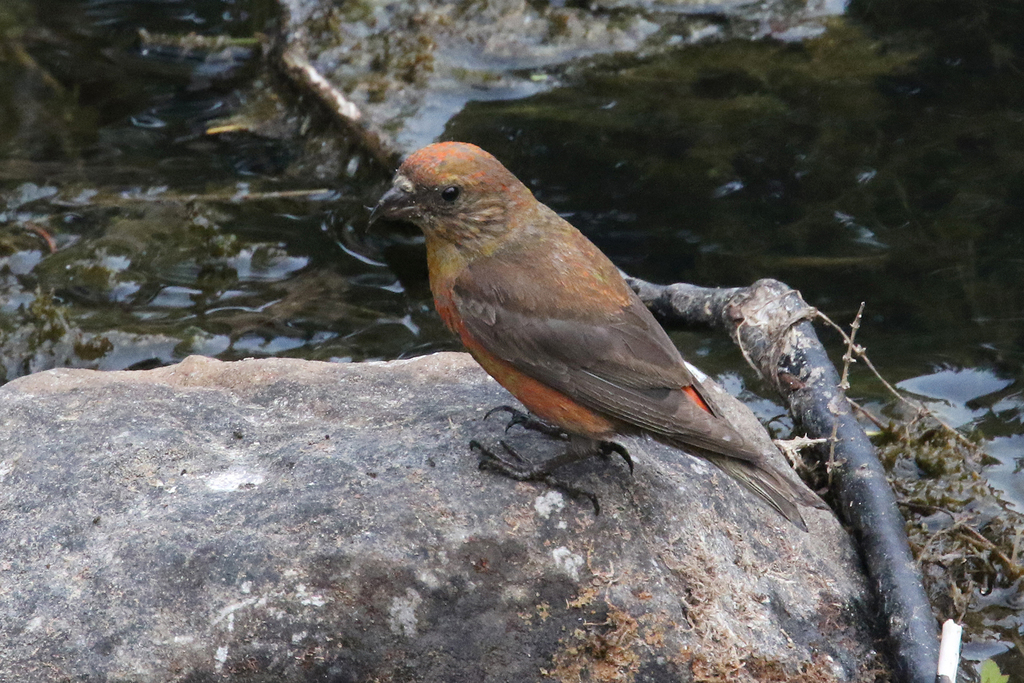
In most of the Rocky Mountains, red squirrels are an important predator of lodgepole pine seeds. They harvest pinecones from the trees and store them through the winter. However, the pine trees are not defenseless: squirrels have a difficult time with wide pinecones that weigh a lot but have fewer seeds. Crossbill birds live in these places and also eat pine seeds, but the squirrels get to the seeds first, so those birds don’t get as many seeds.
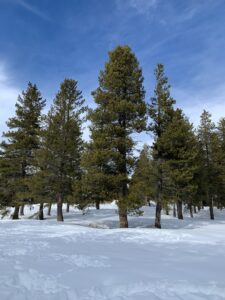
However, in a few isolated places, there are no red squirrels, and crossbills are the most important seed predator for lodgepoles. Again, the trees are not defenseless: crossbills have more difficulty getting seeds from cones with large, thick scales. But the birds have a mode of counterattack: crossbills with deeper, shorter, less curved bills are better able to extract seeds from tough cones.
Close ecological relationships (like the predator/prey relationship described above) set the stage for coevolution to occur. But did it actually happen in this case? To figure that out, we need evidence that suggests that the prey (the trees) have evolved in response to the predator (squirrels or birds) and that the predator has evolved in response to the prey. Researchers Craig Benkman, William Holimon, and Julie Smith set out to see if their observations would support the hypothesis of coevolution.
The scientists reasoned that if coevolution had occurred they would expect to observe the following:
- Differences between pinecones from different regions
If the trees have evolved in response to their seed predators, we should observe geographic differences in pinecones: where squirrels are the main seed predator, trees would have evolved stronger defenses against squirrel predation, and where birds are the main seed predator, trees would have evolved stronger defenses against bird predation. This turned out to be true. Where there are squirrels, the pinecones are heavier with fewer seeds, but have thinner scales, like the pinecone on the left. Where there are only crossbills, pinecones are lighter with more seeds, but have thick scales.
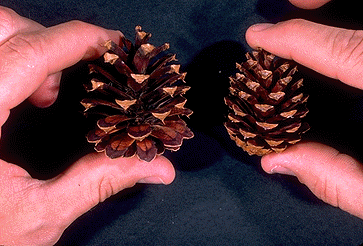
- Geographic differences between predators that correspond to differences in prey
If the crossbills have evolved in response to the pine trees, we should observe geographic differences in birds: where the pinecones have thick scales, birds would have evolved deeper, less curved bills, which are better for getting seeds out of tough cones, than they have where the pinecones have thin scales. This also turns out to be true.
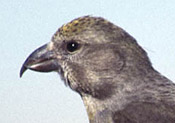
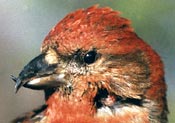
So we have evidence that the trees have experienced natural selection and adapted to the birds (and the squirrels) and that the birds have adapted to the trees. (However, note that we don’t have evidence that the squirrels have adapted to the trees.) It’s easy to see why this is called a coevolutionary arms race: it seems possible for the evolutionary “one-upping” to go on and on…even thicker-scaled pinecones are favored by natural selection, which causes deeper-billed birds to be favored, which causes even thicker-scaled pinecones to be favored, and so on…
Read more about arms races.
Learn about another example of an arms race: Biological warfare and the coevolutionary arms race, a case study.
Reviewed and updated, June 2020.