 UC Berkeley
The work of Emilia Huerta-Sánchez
by the Understanding Evolution team
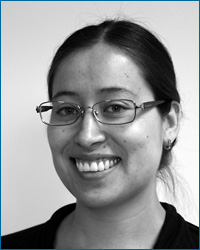
It wasn’t long ago that population geneticist Emilia Huerta-Sánchez took her first biology class. As a math major and then an applied math graduate student, she’d just never had a reason to study biology — that is, until her Ph.D. advisor suggested that she apply her statistical skills to a problem in evolution: what occurs in a population when the strength of natural selection varies from generation to generation? “At first, it was difficult,” says Emilia. “My colleagues assumed that I understood evolution, and I didn’t.” But of course, she soon got her footing, and now she’s caught the biology bug. “Everybody should take a biology class,” she says. “A lot of people don’t even know what DNA is or how natural selection works — and they are missing out on all these cool discoveries!”
For Emilia, biology’s lure lies in human evolution. “We know that as humans have colonized the world, they’ve encountered different environments — changes in temperature, changes in diet, changes in pathogen exposure, changes in altitude,” she explains. “How did they do this? What genetic mutations provided them with the ability to live in those environments?” As a postdoctoral scholar at UC Berkeley, Emilia is tackling such questions. She is particularly intrigued by Tibetan highlanders, who thrive at 13,000 feet above sea level — a height that, for most people, would lead to serious altitude sickness. How do the Tibetans do it? Emilia’s current work aims to uncover the unique adaptations that make it possible to live in some of the highest regions on Earth.
In this research profile, we will explore these key questions:
- What is the difference between acclimatization and adaptation?
- How are allele frequencies used to identify cases of recent natural selection?
- How can mathematical modeling be used to learn about evolutionary history?
- How can changes in non-coding DNA lead to evolutionary change?
Get tips for using research profiles, like this one, with your students.
This material is based upon work supported by the National Science Foundation under Grant Number 1044392. Any opinions, findings, and conclusions or recommendations expressed in this material are those of the author(s) and do not necessarily reflect the views of the National Science Foundation.