 UC Berkeley
Life’s history has been occasionally interrupted by larger and smaller extinction events. Some (like the end-Triassic extinction already described) wiped out a huge portion of all organisms living at the time; other events were more localized. In the mid-Jurassic (about 180 million years ago), ocean-dwellers experienced one of these localized extinction events that killed off 33-53% of marine species living at the time.
Unraveling the cause of this extinction has been a challenge, but we do have a few important leads. From the geologic record, we know that these extinctions occurred around the same time that a mysterious layer of black rock was deposited. This black shale, sometimes several meters thick, appears in sediments around the world. Scientists think that this shale was formed when the world’s oceans became depleted of oxygen. During this time, dead marine organisms formed a carbon-rich layer on the ocean floor that was eventually transformed into black shale. Because this oceanic oxygen depletion event (and many other events like it) seems to be correlated with times of unusually intense volcanic activity, many scientists have hypothesized that atmospheric or climatic changes may have played a role in triggering these depletion events, though they have not yet worked out all the details. But how exactly could volcanoes and volcanic events have changed the atmospheric composition in the mid-Jurassic in the first place? Jennifer set out to investigate.
More data gathering yields new clues
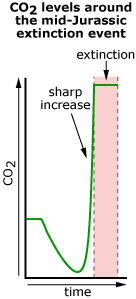 Once again, Jennifer turned to fossil leaves deposited before, during, and after the extinction and oxygen depletion events. The stomata on the leaves confirmed that those events coincided with high levels of carbon dioxide in the atmosphere (i.e., few stomata), but they also turned up something totally unexpected. Just before the extinction event, there was a sudden spike in the density of stomata on fossil plants — suggesting a low point in carbon dioxide levels just before the extinctions! But during the extinction event, carbon dioxide levels were quite high. So carbon dioxide levels must have increased remarkably rapidly — from a low shortly before the mass extinction to a high during the extinctions just 50,000 years later.
Identifying a culprit
What could have caused such a rapid increase in carbon dioxide levels? Jennifer thought that some major tectonic disturbance must have been responsible — but what could it have been? One key clue was the geology of Antarctica and South Africa. In both these regions, geologists have found huge beds of once-molten rock alongside and sandwiched into deposits of scorched coal. Dating techniques suggest that these rock beds were formed around the same time that carbon dioxide levels skyrocketed in the mid-Jurassic. Furthermore, this all coincided with the period in which Gondwana – an ancient super continent – broke up into the modern land masses that we know today.
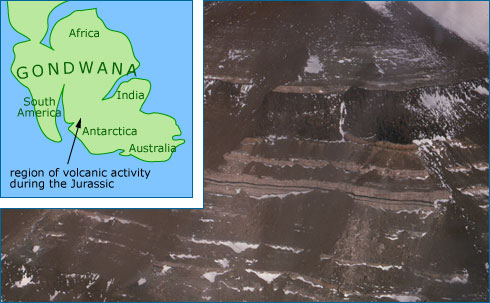
Jennifer has pieced these clues together into a plausible hypothesis to explain the rapid increase in carbon dioxide levels. It is likely that as Gondwana fragmented, floods of extremely hot (over 1000° C!), molten rock oozed out from the Earth’s interior. With this volcanic outpouring would have come a release of greenhouse gasses — but even worse, some of this molten rock may have worked its way into underground coal deposits from Carboniferous and Permian times and set them on fire. This would have led to massive underground coal fires releasing enormous amounts of methane (another important greenhouse gas) and carbon dioxide in a short period of time. Of course, future studies will provide more data relevant to this hypothesis, but at least initially, it seems to fit well with what we know about geologic activity at that time.
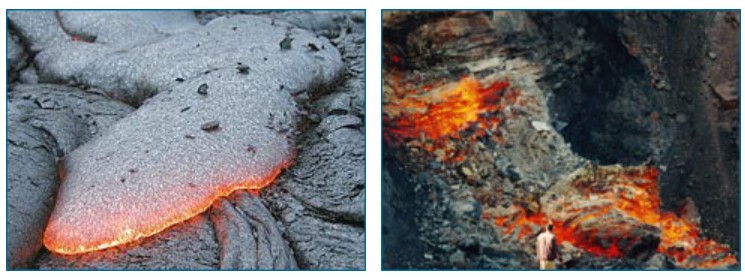
Jennifer points out that those coal fires (and the extinctions they may have triggered) bear a remarkable similarity to humans’ reliance on fossil fuels today. “It’s very analogous to what we’re doing today. Humans are burning coals today that were formed in Carboniferous and Permian times. So what we are doing is totally equivalent to what these dolorite sills [the molten rock that oozed into coal deposits] were doing in the Jurassic — they’re rapidly burning carbon that was stored for millions and millions of years before, and they’re putting the whole carbon cycle out of balance.”
Dig deeper: Find out more about the carbon cycle in Journey of a carbon atom.
Learn more on Understanding Global Change about:
Get tips for using research profiles, like this one, with your students.