 UC Berkeley
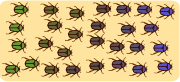 In parapatric speciation there is no specific extrinsic barrier to gene flow. The population is continuous, but nonetheless, the population does not mate randomly. Individuals are more likely to mate with their geographic neighbors than with individuals in a different part of the population’s range. In this mode, divergence may happen because of reduced gene flow within the population and varying selection pressures across the population’s range.
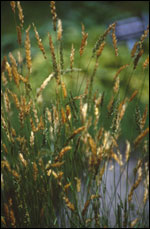
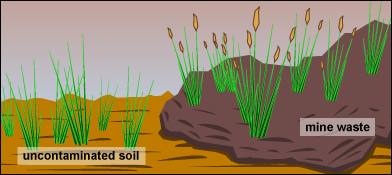
We may be observing the first steps of parapatric speciation in the grass species Anthoxanthum odoratum (at right). Some of these plants live near mines where the soil has become contaminated with heavy metals. The plants around the mines have experienced natural selection for genotypes that are tolerant of heavy metals. Meanwhile, neighboring plants that don’t live in polluted soil have not undergone selection for this trait. The two types of plants are close enough that tolerant and non-tolerant individuals could potentially fertilize each other — so they seem to meet the first requirement of parapatric speciation, that of a continuous population. However, the two types of plants have evolved different flowering times. This change could be the first step in cutting off gene flow entirely between the two groups.
Learn more about speciation:
- A closer look at a classic ring species: The work of Tom Devitt, a research profile.
- Sex, speciation, and fishy physics, a news brief with discussion questions.
Teach your students about speciation:
Find additional lessons, activities, videos, and articles that focus on speciation.