 UC Berkeley

Since all cells in our body contain DNA, there are lots of places for mutations to occur; however, not all mutations matter for evolution. Somatic mutations occur in non-reproductive cells and so won’t be passed on to offspring.
For example, the yellow color on half of a petal on this red tulip was caused by a somatic mutation. The seeds of the tulip do not carry the mutation. Cancer is also caused by somatic mutations that cause a particular cell lineage (e.g., in the breast or brain) to multiply out of control. Such mutations affect the individual carrying them but are not passed directly on to offspring.
The only mutations that matter to large-scale evolution are those that can be passed on to offspring. These occur in reproductive cells like eggs and sperm and are called germ line mutations.
Effects of germ line mutations
A single germ line mutation can have a range of effects:
- No effect or neutral effect
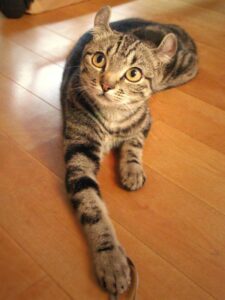
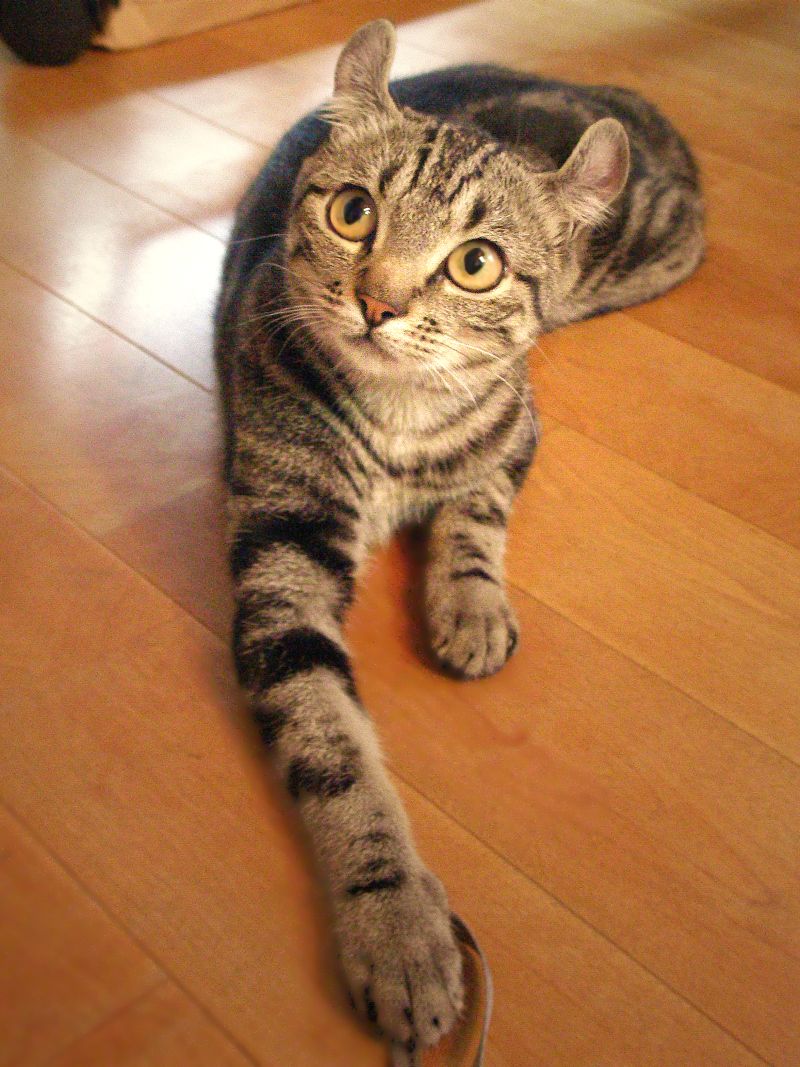
Image courtesy of Tanakawho’s Flickr, under the Creative Commons Attribution 2.0 Generic license. Some mutations don’t have any noticeable effect on the organism. This can happen in many situations: perhaps the mutation occurs in a stretch of DNA with no function, or perhaps the mutation occurs in a protein-coding region, but does not affect the amino acid sequence of the protein. Other mutations have a noticeable effect, but one that doesn’t seem to help or hurt. For example, a single mutation caused this cat’s ears to curl backwards slightly, a trait that doesn’t seem to affect its health.
- Detrimental effect
Some mutations harm an organism’s ability to survive and reproduce. For example, in humans, Marfan syndrome is caused by a mutation affecting a protein that forms part of connective tissue, leading to heart problems and other health challenges. Detrimental mutations known as lethals disrupt DNA critical to survival and cause the death of the organism.
- Beneficial effect
Other mutations are helpful to the organisms that carry them. For example, DDT resistance in insects is sometimes caused by a single mutation. While resistant insects might be downer for us, they are undoubtedly helpful for bugs trying to survive on pesticide-laden crops.

According to popular culture, it seems that mutations mainly cause either cancer or superpowers. Of course, the cancer is true enough. But in the real world, beneficial mutations are rare. Most mutations have no effect or a detrimental effect. And major evolutionary change (e.g., the “superpower” of flight in bats!) generally involves the accumulation of many, many mutations over many, many generations, with a few notable exceptions…
Little mutations with big effects: Mutations to control genes
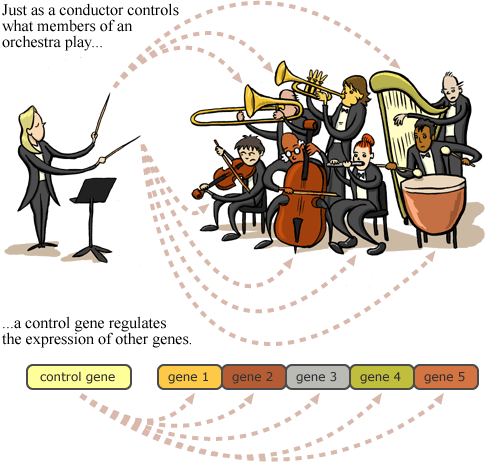
Some regions of DNA control other genes, determining when and where other genes are turned “on”. Mutations in these parts of the genome can substantially change the way the organism is built. The difference between a mutation to a control gene and a mutation to a less powerful gene is a bit like the difference between whispering an instruction to the trumpet player in an orchestra versus whispering it to the orchestra’s conductor. The impact of changing the conductor’s behavior is much bigger and more coordinated than changing the behavior of an individual orchestra member. Similarly, a mutation in a gene “conductor” can cause a cascade of effects in the behavior of genes under its control.
Many organisms have powerful control genes that determine how the body is laid out. For example, Hox genes are found in many animals (including flies and humans) and designate where the head goes and which regions of the body grow appendages. Such master control genes help direct the building of body “units,” such as segments, limbs, and eyes. So evolving a major change in basic body layout may not be so unlikely; it may simply require a change in a Hox gene and the favor of natural selection.
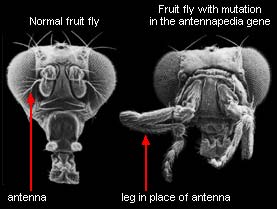
Weird Fact: Mutations to control genes can transform one body part into another. Scientists have studied flies carrying Hox mutations that sprout legs on their foreheads instead of antennae!