 UC Berkeley
At the dawn of the sixteenth century, European scholars could gain only a crude understanding of the anatomy of humans and animals. At the handful of universities where students trained in medicine—such as Bologna or Paris—professors read from the books of the Greek physician Galen. Galen had combined the philosophical work of Aristotle and other Greeks with his own lifetime of dissections, creating a system that explained not just the structure of the human body, but how the body worked.
After the fall of Rome, Galen’s legacy lived on in Arab cities like Baghdad, where his work was translated, pored over, and encrusted with interpretations and commentaries. In the 1100s, Europeans began to translate Galen from Arabic and made his work the basis of medical training. But in the many steps of translation, much of the spirit of Galen’s work—especially his emphasis on observing for oneself rather than relying on authority—was lost. A tradition had emerged in which professors read Galen to their students, while a surgeon dissected an executed criminal to show the relevant parts of the body. There was no point in the professor looking for himself at the body, since everything worth learning could be found in Galen’s books.
Observing the human body

A young Flemish anatomist changed all that when he realized that Galen was dramatically wrong. Andreas Vesalius (1514-1564) started out his career as a defender of “Galenism” at the University of Paris. But when he moved to the University of Padua, he began dissecting corpses for himself to show his students the fine details of anatomy. He drew charts for the students to study, and the exquisite quality of the charts made Vesalius famous—so famous that the criminal court judge of Padua made sure he had a steady supply of cadavers from the gallows.
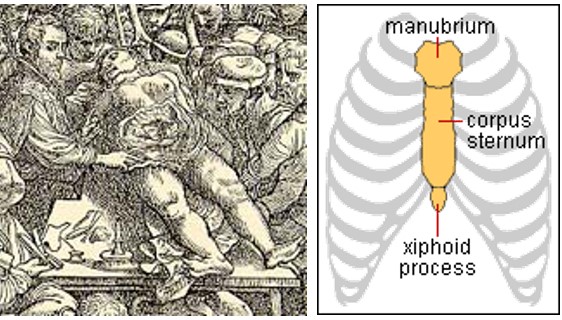
As he grew more familiar with the human body, Vesalius began to notice that here and there, Galen had made mistakes. The human breastbone is made of three segments; Galen said seven. Galen claimed that the humerus (the upper arm bone) was the longest bone in the body, save only the femur; Vesalius saw that the tibia and fibula of the shin pushed the humerus to fourth. Over the centuries, anatomists sometimes had minor quibbles with Galen, but Vesalius began to suspect that there was something seriously wrong with his work. Vesalius widened his scope, dissecting animals, and reading over his Galen more carefully. The source of the mistake dawned on him. Galen had never dissected a human. The traditions of Rome did not allow such a practice, and so Galen had had to make do with dissecting animals and examining his patients during surgery. Instead of humans, Galen was often writing about oxen or Barbary macaques.
Challenging Galenism
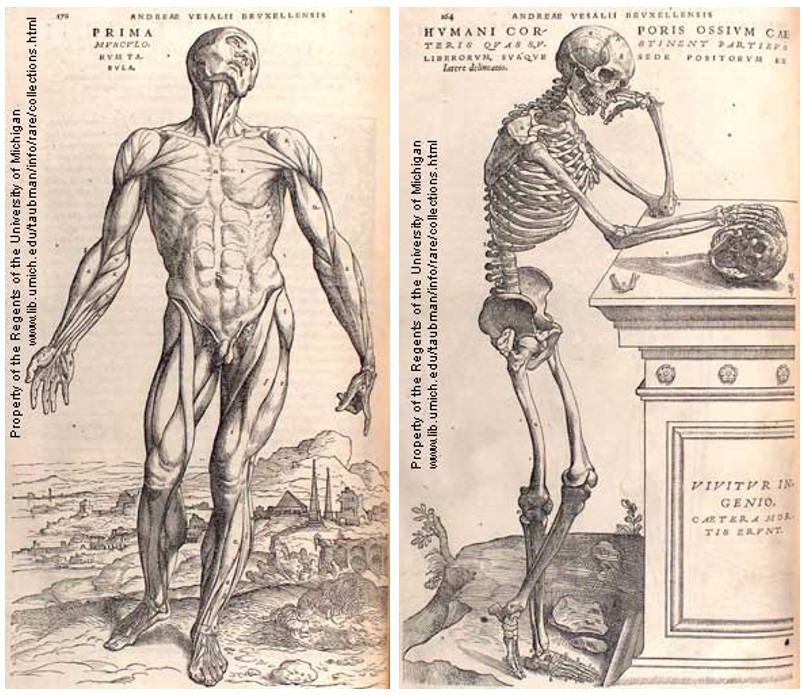
At age 25, Vesalius launched a full assault on Galen. Lecturing at Padua and then at Bologna, he rigged up skeletons of humans and of Barbary macaques, and showed the assembled students how wrong Galen had been. Vesalius then set out to put together a new anatomy book that included his discoveries. Over the next four years Vesalius worked with the finest block cutters of Venice and draftsmen from Titian’s workshop. He named his book De humani corporis fabrica libri septem, or “The Seven Books on the Structure of the Human Body”—commonly known as the Fabrica. In this 1543 masterwork, men and women now stood stripped of skin (left). Skeletons (right) leaned lazily against columns in the rolling Italian countryside.
Humans are not so unique
Fabrica launched a new tradition in anatomy in Europe, in which anatomists trusted only their own observations and explored the body like a new continent. Vesalius’ discovery of the important differences between species also helped usher in the science of comparative anatomy, in which researchers studied animals to find their similarities and differences. In the process, they gradually began to recognize humans as being one species among many, with a few unique traits but many others shared in common with other animals. Some 300 years after Vesalius first shook off the blind obedience to Galen, Darwin used that vast stock of anatomical knowledge to build his theory of evolution.