 UC Berkeley
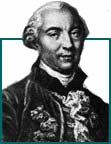 No single naturalist of the 1700s epitomizes the revolutionary changes that the Enlightenment brought to the study of nature more than Georges-Louis Leclerc, Comte de Buffon (1707-1788). In the 1600s most naturalists believed the world was a few thousand years old and that species were created separately and organized into an unchanging hierarchy, with humans positioned just below the angels. In the 1800s, Darwin described a world that was inconceivably old, one in which life gradually changed from one form to another without any need for direct supernatural intervention. Roughly midway between those two views—both chronologically and intellectually—was the remarkable Georges-Louis Leclerc Buffon.
Buffon’s career centered on a single enormous project: an encyclopedia he called Histoire Naturelle, which he planned to contain everything known in his day about the natural world. (Buffon only managed to publish 36 out of his projected 50 volumes before he died.) To create it, he was able to draw on his own astonishing expertise, which ranged from astronomy to botany, as well as the knowledge of experts he consulted. But in writing his encyclopedia he did not merely parrot the opinions of others. Instead, he tried to explain all of the facts he amassed with overarching theories about the planet and its inhabitants.
A non-Biblical explanation of Earth’s history

Buffon realized that to interpret the world, he had to understand its history. And despite censures from the Church, he did not rely on the Bible as a strict guide to that history. Instead, he used the new physics of Isaac Newton to conjecture how matter in motion might have formed the Earth. He proposed that a comet striking the sun had broken off debris that became the planets of the solar system. Initially, the Earth was scorching, but gradually it cooled until molten rock turned to dry land and clouds rained down to form oceans. Buffon estimated the entire process took over 70,000 years. To most Europeans of Buffon’s time, who considered the Earth to be fewer than 7,000 years old, this was practically an eternity.
Spontaneous origins of life
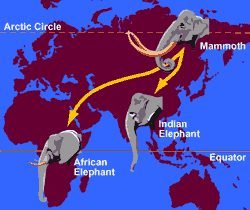
Buffon argued that life, just like Earth, had a history. Like many other Enlightenment thinkers, he thought that it could be generated spontaneously under the right conditions. In the hot oceans of the early Earth, Buffon claimed that vast amounts of life were generated from unorganized matter—even large animals sprang into existence. In time, as the world’s climate cooled, many animals migrated to the tropics. Their migration made sense of the discoveries in Buffon’s day of fossil elephants in Siberia and North America, while living elephants were only found in Africa and South Asia (see figure, right). The Siberian species gave rise to today’s elephants, while the North American forms simply became extinct.
Change through migration
According to Buffon, life originated already divided into a number of distinct types—an “internal mould” that organized the organic particles that made up any individual creature. But during migrations, life changed. As a species moved to new habitats, the supply of organic particles that could create new individuals changed, and the particles could thereby change a species’ mould. Buffon was, in other words, proposing a sort of proto-evolution. While he thought that this process couldn’t produce radically new kinds of body plans, he did claim that it could account for the geographical distribution of similar species around the world.
Buffon’s theories were visionary yet doomed, because they were based on the relatively skimpy evidence that eighteenth-century naturalists had at their disposal. His estimate of the Earth’s age turned out to be far too young, and his notions of biological change were not based on a coherent mechanism. Yet his theories foreshadowed some of the most important developments in the natural sciences in the decades that followed his death—from Cuvier’s discoveries about extinctions, to the evidence that Lyell and other geologists found for a vast age of the planet and life itself, to Darwin’s own theory of evolution. It may be true that no single idea of Buffon’s has withstood the test of time. But his work was still a milestone of science because he thought about the Earth and life in ways that few had before—both life and the Earth had a history.