 UC Berkeley
Recombination introduces new gene combinations into populations.
Here is a quick and dirty review of the genetics of sexual reproduction. We’ll use human reproduction to anchor this because it’s a familiar topic, but the basic ideas transfer to other sexually reproducing organisms.
- Genes are located on long chains of DNA called chromosomes.
- Humans have 23 pairs of chromosomes: one member of each pair was inherited from the mother and the other from the father. Correspondingly, we have two versions of every gene, one from the mother and one from the father.
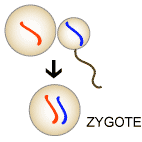 If people reproduced by taking 23 pairs of chromosomes from the mother and 23 pairs of chromosomes from the father, the baby would have too many chromosomes (46 pairs). So eggs and sperm carry only half the usual number of chromosomes — just 23 unpaired chromosomes, carrying one version of each gene. When the egg and sperm get together, the baby receives the normal 23 matched pairs.
Here’s how egg and sperm are produced:
- The parent cell first copies each chromosome, leaving the duplicate pairs attached to one another.

- Producing eggs and sperm is our first opportunity for mixing and matching genes. When the mother makes an egg, her chromosomes first find their matched partners and exchange some DNA with each other. That’s called recombination. Because of this shuffling, genes from the mother’s mom and genes from the mother’s father can wind up next to one another on the same stretch of DNA. (The same thing happens in the father’s sperm.)
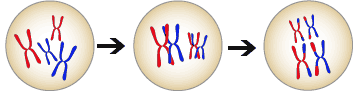
- Only after chromosomes recombine do they segregate into different egg cells, so that each egg cell ends up with one version of each chromosome.
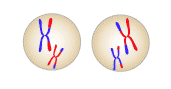
- In step one of meiosis, members of each homologous pair of chromosomes are pulled into separate daughter cells, producing two cells:
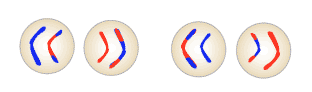
- In step two of meiosis, each diploid chromosome above is pulled apart into separate daughter cells, generating four separate cells, each containing just one copy of each gene:
- In step one of meiosis, members of each homologous pair of chromosomes are pulled into separate daughter cells, producing two cells:
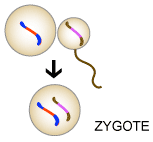
- When egg and sperm meet, the baby inherits a combination of genes that is totally unique: it carries versions of genes from all 4 grandparents plus any mutations that occurred when the mother and father were making the egg and sperm.