 UC Berkeley
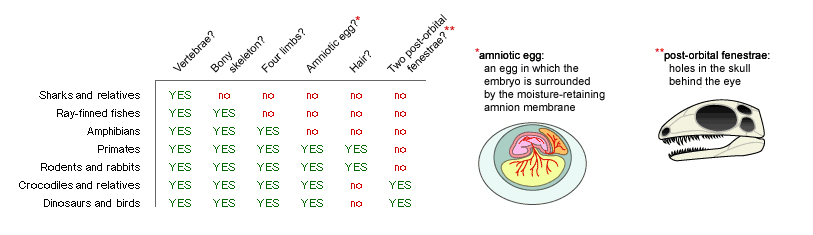
After studying some major vertebrate lineages and limiting the data to characters that are likely homologous, you might end up with the following evidence (note that there are many vertebrate lineages and many characters excluded from this example for the sake of simplicity):
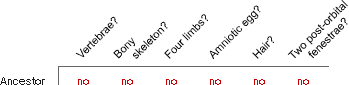
From studying fossils and lineages closely related to the vertebrate clade, we hypothesize that the ancestor of vertebrates had none of these features:
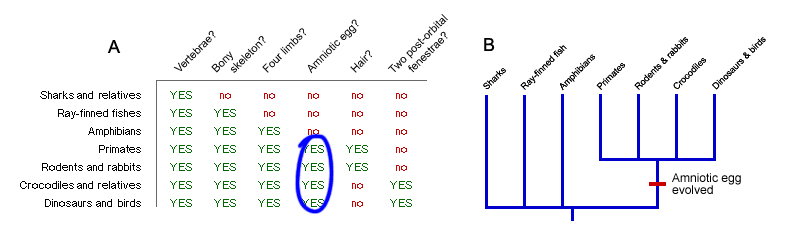
To build a phylogenetic tree from these data, we must base our clades on shared derived characters — not shared ancestral characters. Since we have a good idea of what the ancestral characters are (see above), this is not so hard. We might start out by examining the egg character. We focus in on the group of lineages that share the derived form of this character, an amniotic egg (A, below), and hypothesize that they form a clade (B):
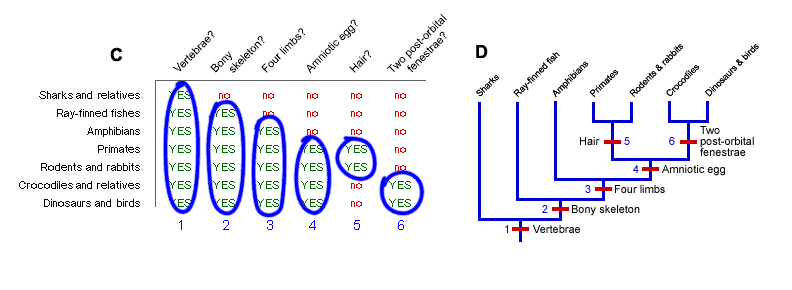
If we go through the whole table like this, grouping clades according to shared derived characters (C, below), we get the following hypothesis (D):
Of course, this was just an example of the tree-building process. Phylogenetic trees are generally based on many more characters and often involve more lineages. For example, biologists reconstructing relationships between 499 lineages of seed plants began with more than 1400 molecular characters!
What is parsimony?
The tree-building process explained above is based on the principle of parsimony. The parsimony principle is basic to all science and tells us to choose the simplest scientific explanation that fits the evidence. In terms of tree-building, that means that the best hypothesis is the one that requires the fewest evolutionary changes.
For example, we could compare these two hypotheses about vertebrate relationships using the parsimony principle:
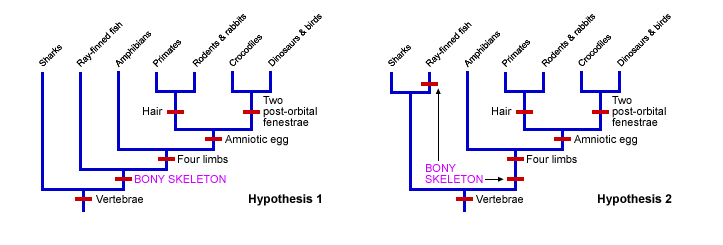
Hypothesis 1 requires six evolutionary changes and Hypothesis 2 requires seven evolutionary changes, with a bony skeleton evolving independently, twice. Although both fit the available data, the parsimony principle says that Hypothesis 1 is better — since it does not hypothesize unnecessarily complicated changes.
This principle was implicit in the tree-building process we went through earlier. However, in most cases, the data are more complex than those used in our example and may point to several different phylogenetic hypotheses. In those cases, the parsimony principle can help us choose between them.
Learn about parsimony in context: Using trees to understand plants: The work of Chelsea Specht, a research profile.
Teach your students about evolutionary relationships and phylogenetics:
Find additional lessons, activities, videos, and articles that focus on phylogenetics.