 UC Berkeley
Homo sapiens, Tyrannosaurus rex, Escherichia coli—our English conversation is littered with pairs of Latin names for animals, plants, and microbes. How did a dead language find this renewed life? It is the 250-year-old legacy of a Swedish naturalist’s quest to discover God’s handiwork in nature.
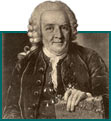
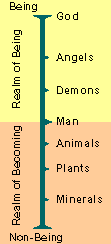
Carolus Linnaeus (1707-1798) was far from the first thinker to try to classify life. Aristotle, for example, argued that each species had a unique form and could be classified by some of its key characteristics. In the process, he organized life in a ladder-like hierarchy, with plants on the bottom, animals in the middle, and humans on top (figure, right). Medieval European scholars were guided by both Aristotle and the Bible, and they believed that nature—including all of the species on Earth—reflected God’s benevolent organization of the world.
Searching for a system of classification
With the advent of the Renaissance, naturalists tried to understand this divine plan by searching for a rational pattern in the bewildering array of species. They grouped species with an overall similarity with one another in a larger group called a genus. Lions, tigers, and leopards, for example, all belonged to a “big cat” genus.
But did big cats and other animals fit into a larger scheme? This was difficult to know for many reasons. One problem was that European explorers and colonists began encountering many previously unknown species in the New World, Africa, and Asia. On top of that was the problem of method. Some argued that naturalists looking for a system of classification should try to take into account as many characteristics of a species as possible. That would ensure that their classification system was truly natural. Others argued that we do not find systems in nature but construct them in our minds. Therefore naturalists should invent artificial systems based on a few convenient traits of their own choosing, such as the shape of a plant’s reproductive organs.
Organizing life into nested hierarchies
Carolus Linnaeus joined the quest for classification after having trained as a physician at the University of Uppsala. Botany was part of every medical student’s preparation, since most medicines were derived from plants. After making botanical expeditions through Lapland and central Sweden, Linnaeus became convinced that he could organize all of life into a single artificial system, one that would be his first step towards comprehending God’s design in nature.
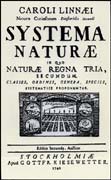
In 1735 he published the first edition of his landmark work, Systema Naturae. In it, he identified every species he knew of according to a standard nomenclature, a genus name followed by a species name. Before Linnaeus, naturalists used unwieldy, irregular names that sowed confusion. But he went further. He classified genera together in groups he called families, which he then placed in larger groups called orders, and then kingdoms, like boxes within boxes.
Humans as primates
Linnaeus’ classification was important in many ways, not the least of which was how he classified humans. He named humans Homo sapiens, and placed us in the genus Homo. He also placed orangutans and chimpanzees, the two apes known at the time, in the genus Homo. And he placed Homo in a family, which he dubbed Primates. Primates also included two other genera, simians and lemurs. Although Linnaeus believed that humans were special beings in God’s creation, he slotted our species into his system as if it were any other.
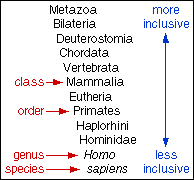
Linnaeus organized life with an almost geometrical precision, and was so impressed by his own system that he used it to organize rocks and other non-living matter. Although his classification of minerals may now be long forgotten, within the biological world, at any rate, Linnaeus’ system proved to be useful. It was clear and straightforward, making the challenge of classifying new species far easier than previous systems. It became the standard way to organize life’s diversity.
Biologists still use Linnaeus’ conventions today when they name a new species. But Darwin rendered the ideas behind those conventions obsolete. Darwin recognized that evolution could produce the hierarchy of similarities that so impressed Linnaeus, as old species gave rise to new species. Biologists still place pigs, porcupines, and people in Mammalia, but they do so because all the evidence—comparisons of fossils, anatomy, and genes— confirms that they descend from a common ancestor.