 UC Berkeley
Ensatina‘s basic story was laid out by Robert Stebbins 30 years before Tom was born in 1977. Based on the ring-like distribution of the different forms, Robert had proposed that the species started off in Northern California and Oregon and then spread south along both sides of the Central Valley, which was too dry and hot for salamanders1.
According to Robert’s hypothesis, as the pioneering populations moved south, they evolved into several subspecies with new color patterns and adaptations for living in different environments. By the time they met again in Southern California as the subspecies eschscholtzii and klauberi, he argued, they had each evolved so much that they no longer interbred — even though the subspecies blended into one another around the rest of the ring. Since species are often defined by their inability to interbreed with other species, Ensatina seemed to represent the whole process of speciation — all the gradual changes that accumulate in two lineages and that wind up making them incompatible with one another.
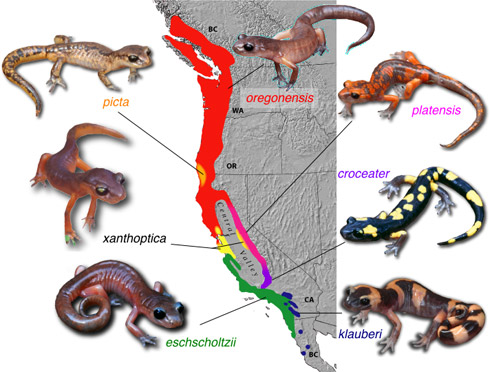
Of course, since this all would have happened millions of years ago, Robert wasn’t around to observe any of it. He based his ideas on the morphology, or body form, of the subspecies — in this case, their color patterns. First, neighboring subspecies were more similar to one another than to those across the ring and seemed to blend into one another. From this, he hypothesized that Ensatina represented a ring species. Robert also noticed that the northern coastal form, called picta, had a pattern of colors that seemed to encompass the other subspecies. It was easy to imagine how the more specialized southern forms could have evolved from picta. Based on this, Robert hypothesized that the two southward-moving Ensatina lineages had both emerged from picta‘s immediate ancestors.
Take a side trip to learn more about the biological species concept — the idea that species are defined by their ability to interbreed.
Get tips for using research profiles, like this one, with your students.
1Stebbins, R.C. 1949. Speciation in salamanders of the plethodontid genus Ensatina. University of California Publications in Zoology 48:377-526.