 UC Berkeley
The work of Tom Devitt
by the Understanding Evolution team
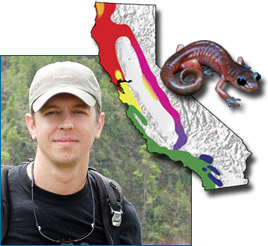
If you’ve skimmed a high school biology textbook, you’ve probably seen the picture: multicolored salamanders meander around California, displaying subtle shifts in appearance as they circle its Central Valley. This is Ensatina eschscholtzii, and it’s so well known because it is a living example of speciation in action. Adjacent populations of the salamander look similar and mate with one another — but where the two ends of the loop overlap in Southern California, the two populations look quite different and behave as distinct species. The idea is that this continuum of salamanders — called a ring species — represents the evolutionary history of the lineage, as it split into two.
Ensatina has been recognized as a ring species since the 1940s, when biologist Robert C. Stebbins trooped up and down California to investigate its range. Since then, several generations of scientists in Stebbins’ institution, the Museum of Vertebrate Zoology at UC Berkeley, have continued these studies, digging deeper into Ensatina’s history and biology. At this point, one might think we’d know it all. What more could there be to learn after 60 years of research on a common salamander? “Lots!” says Tom Devitt, a graduate student at the museum. Tom studies Ensatina to flesh out its evolutionary history — but not just for Ensatina’s sake. This classic example sheds light on the basic evolutionary processes that shape all life.
In this research profile, we will explore these key questions:
- What are ring species?
- How are multiple lines of evidence used to evaluate a single hypothesis?
- How can experiments be used to learn about evolutionary history?
- What biological mechanisms contribute to reproductive isolation and speciation?
Learn more about species ranges on the Understanding Global Change site.
Get tips for using research profiles, like this one, with your students.