 UC Berkeley
An adaptation is a feature produced by natural selection for its current function. Based on this definition we can make specific predictions (“If X is an adaptation for a particular function, then we’d predict that…”) and see if our predictions match our observations. As an example, we’ll consider the hypothesis: feathers are an adaptation for bird flight. Is the evidence consistent with this hypothesis?
-
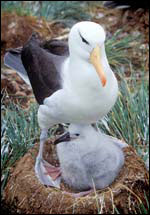
Image courtesy of Gerald and Buff Corsi, Focus on Nature, Inc. Heritable
If it has been shaped by natural selection, it must be genetically encoded — since natural selection cannot act on traits that don’t get passed on to offspring. Are feathers heritable? Yes. Baby birds grow up to have feathers like those of their parents. - Functional
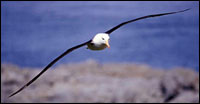
Image courtesy of Gerald and Buff Corsi, Focus on Nature, Inc. If it has been shaped by natural selection for a particular task, the trait must actually perform that task. Do feathers function to enable flight? In the case of bird flight, the answer is fairly obvious. Birds with feathers are able to fly and birds without feathers would not be able to.
- Adaptive
If it has been shaped by natural selection, it must increase the fitness of the organisms that have it — since natural selection only increases the frequency of traits that increase fitness. Are birds more fit with feathers than without? Birds without feathers aren’t going to leave as many offspring as those with feathers.
We could do experiments to test each of these criteria of adaptation. So far so good — the feature could have been shaped by natural selection. But we also have to look at historical questions about what was going on when it arose. Did feathers arise in the context of natural selection for flight?
 Current function
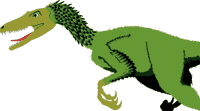
Did the trait arise when the current function arose? Did feathers arise when flying arose? The answer to this is probably no. The closest fossil relatives of birds, two-legged dinosaurs called theropods, appear to have sported feathers but could not fly.
So perhaps the basic form of feathers is not an adaptation for flight even though it certainly serves that function now. It may be an exaptation for flight and an adaptation for some other function. Answering questions like these, has led biologists to look for alternate scenarios for the initial evolution of feathers.
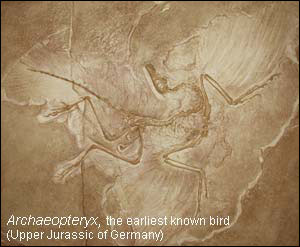
This last question emphasizes the importance of understanding organisms’ history through fossils such as Archaeopteryx and reconstructed phylogenies. It is not enough to know that the feature is functional right now. We want to know what was happening when it first evolved, which often involves reconstructing the phylogeny of the organisms we are interested in and determining the likely ancestral states of the characters.
Learn more about adaptations in context:
- Biological warfare and the coevolutionary arms race, a case study.
- Quick bites and quirky adaptations, a news brief with discussion questions.
Teach your students about adaptations with Form and function, a classroom activity for grades K-2.
Find additional lessons, activities, videos, and articles that focus on adaptations.