 UC Berkeley
Through sampling error, genetic drift can cause populations to lose genetic variation.
Decreasing variation
Imagine that our random draws from the marble bag produced the following pattern: 5:5, 6:4, 7:3, 4:6, 8:2, 10:0, 10:0, 10:0, 10:0, 10:0… Why did we keep drawing 10:0? Because if the green marbles fail to be represented in just one draw, we can’t get them back — we are “stuck” with only brown marbles. The cartoon below illustrates this process, beginning with the fourth draw.
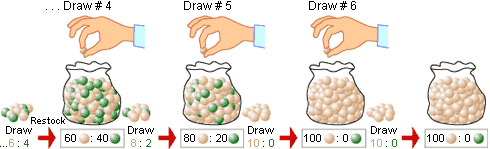
The same thing can happen to populations. If the gene for green coloration drifts out of the population, the gene is gone for good — unless, of course, a mutation or gene flow reintroduces the green gene.
The 10:0 situation illustrates one of the most important effects of genetic drift: it reduces the amount of genetic variation in a population. And with less genetic variation, there is less for natural selection to work with. If the green gene drifts out of the population, and the population ends up in a situation where it would be advantageous to be green, the population is out of luck. Selection cannot increase the frequency of the green gene, because it’s not there for selection to act on. Selection can only act on what variation is already in a population; it cannot create variation.
The impact on small populations
The marble-drawing scenario also illustrates why drift affects small populations more. Imagine that your bag is only big enough for 20 marbles (a tiny bag!) and that you can only draw four marbles to represent gene frequencies in the next generation. Something like this might happen:
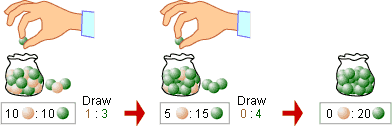
Notice how quickly and drastically the marble ratio changed: 1:1, 1:3, 0:1.
The same process operates in small populations. All populations experience drift, but the smaller the population is, the sooner drift will have a drastic effect. This may be a big problem for endangered species that have low population sizes.