 UC Berkeley
The key to speciation is the evolution of genetic differences between the incipient species. For a lineage to split once and for all, the two incipient species must have genetic differences that are expressed in some way that causes matings between them to either not happen or to be unsuccessful. These need not be huge genetic differences. A small change in the timing, location, or rituals of mating could be enough. But still, some difference is necessary. This change might evolve by natural selection or genetic drift.
Reduced gene flow probably plays a critical role in speciation. Modes of speciation are often classified according to how much the geographic separation of incipient species can contribute to reduced gene flow. Here, we’ll explore these modes of speciation:
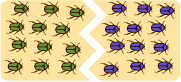
Allopatric (allo = other, patric = place): New species formed from geographically isolated populations.
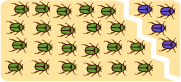 Peripatric (peri = near, patric = place): New species formed from a small population isolated at the edge of a larger population.
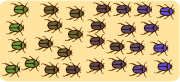 Parapatric (para = beside, patric = place): New species formed from a continuously distributed population.
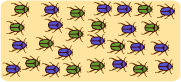 Sympatric (sym = same, patric = place): New species formed from within the range of the ancestral population.
Learn more about speciation:
- A closer look at a classic ring species: The work of Tom Devitt, a research profile.
- Sex, speciation, and fishy physics, a news brief with discussion questions.
Teach your students about speciation:
Find additional lessons, activities, videos, and articles that focus on speciation.