
Understanding Evolution: your one-stop source for information on evolution
Resource library Teaching materials Evolution 101

Active-learning slides for undergraduate evolution instruction
by the Understanding Evolution team

Pedagogical research indicates that students learn better if they are actively engaged, rather than passively listening to or reading information. Undergraduate instructors accustomed to delivering a certain amount of content per lecture may find it difficult to begin to implement active learning techniques in the classroom. However, active learning doesn't mean you have to change your whole teaching style. This document describes three types of activities that are simple to introduce into a primarily lecture-based course, that can be incorporated into a slide presentation, and that help increase the level of active pedagogy: minute papers, personal response questions, and problem-based discussions.

  • Minute papers. One of the simplest active learning techniques is the "minute paper."1 Minute papers are brief, in-class writing exercises, typically carried out at the end of a class session, but easily administered at any time during class. Instructors ask students to write a few sentences (or more) about some aspect of the class session that day or of the course as a whole. For example, instructors may ask students to list what they think were the major points of a class session, to reflect upon some aspect of the lesson that day, or to formulate and express an opinion. In any case, students become engaged in the sense that they are responsible for constructing a written response. Minute papers have become a widely used technique for actively engaging students and provide an excellent way to break up a class session. The papers can be read after class by the instructor and used to determine the direction of future instruction or graded with a check/check-plus/check-minus system. This is easily accomplished even on a short time frame if minute papers are administered at the end of a class session. See sample minute paper slides on evolution.

  • Personal response questions/clicker questions. These multiple choice questions are presented to the class as a whole to check the current state of student understanding and/or to advance understanding in some way. A slide with the question is inserted into the lecture. The class can use response technology (like "clickers" and supporting software or cell phone response applications) to record their answers, which are then presented as a histogram on the screen. A lower cost option is for students to hold up colored pieces of paper (red = A, yellow = B, etc.), allowing the instructor to visually assess the distribution of responses. The instructor can have students respond individually or after short group- or pair-discussions. Used at the beginning of class, this type of question can assess how well students have understood assigned reading or material presented in the previous lecture. During the lecture, the instructor can use these questions to assess current understanding of the lecture material, and based on the result, can further elucidate the concept. The responses may reveal an underlying student misconception, which can then be addressed.

    Instructors that have become more comfortable with this type of pedagogy may want to implement a more sophisticated use of this technique which helps students recognize and correct their own misconceptions. In this technique, students reply to the personal response question as usual, but then, before the correct answer is shown, students are asked to discuss the topic with a partner and explain their answers. The same question can then be asked again, and histograms of the answers before and after discussion can be shown. In the majority of cases, students "self-correct" during these exercises. If you wish, an additional item testing the same concept can be developed and asked immediately following this exercise in order to reinforce the correct conception. Clicker questions may also be extended to include more than one right answer or an open-ended component ("What might the common ancestor of humans and chimps look like? Explain why.") The instructor may call on individual students to offer their explanations. See sample personal response question slides on evolution.

  • Problem-based discussions. Problem-based discussions are a valuable active learning technique that involves students teaching each other, thus promoting student engagement and learning. Frequently, students think they understand a concept when it is presented to them in lecture, but may recognize gaps in their understanding when they have to explain/teach to others. In this technique, the instructor posts a written description of a scientific problem or a diagram, table, or graph relevant to a topic under consideration. The instructor provides a list of questions that students should work to answer. Students then spend 5-10 minutes, first thinking individually about the questions in reference to the problem or figure, and then pair up and take turns explaining their answers to each other and filling gaps in each other's knowledge. This helps students assess how well they understand the problem and provides an illustration of the level of analysis faculty expect students to be able to engage in. At the end of the discussion, the instructor can read aloud the questions, either verbatim or modified to be slightly different, and ask whether students are confident they could explain the issues to each other. The instructor may wish to call on students to answer individual questions, or may ask if the discussion raised any questions they would like to ask in class. See sample problem-based discussion slides on evolution.

The three activities described above are provided as a starting point for instructors wishing to incorporate active learning into their classrooms. PowerPoint slides illustrating these approaches and using evolutionary topics as examples are available for download below. With increased experience, the instructor will be able to modify and extend these activities, optimizing them for particular applications and topics.

Sample minute paper slides
Click the questions below in order to download individual slides, or click here to download the whole slide set.

  1. What is evolution?

  2. Is evolution a theory, a fact, or something else entirely? Why?

  3. What evidence supports the theory of evolution?

  4. What is the fossil record's unique contribution to our understanding of evolution?

  5. What do you think it means when a species is called a "living fossil?"

  6. What are transitional features?

  7. Is it correct to say that humans evolved from chimpanzees? Why or why not?

  8. Describe the mechanisms of evolution.

  9. In order for natural selection to occur in a system, what characteristics must the system have?

  10. Do vestigial structures necessarily disappear through evolution?

  11. Is antibiotic resistance an example of evolution?

  12. What does it mean to be fit in an evolutionary sense?

  13. Why are small populations more strongly affected by genetic drift than large ones?

  14. What is coevolution?

  15. Compare and contrast the biological species concept and the phylogenetic species concept.

  16. Describe a situation in which it would be difficult to apply the biological species concept and explain why it would be difficult.

  17. How is allopatric speciation similar to and different from sympatric speciation?

  18. Select the more parsimonious phylogeny.
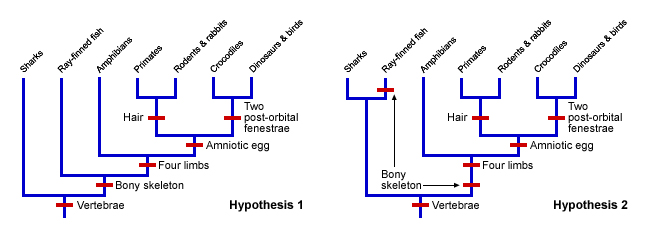
Two hypotheses

Sample personal response question slides
Click the topics below in order to download the slide, or click here to download the whole slide set.

  1. Randomness of mutation

  2. How natural selection works

  3. Natural selection misconception in the context of head lice

  4. Natural selection misconception in the context of bacteria

  5. Fitness definition

  6. Survival of the fit enough

  7. Genetic drift misconception

  8. Genetic drift and fixation

  9. Population genetics calculation

  10. Topology of equivalent phylogenies

  11. Phylogenetic misconception

  12. Reading a phylogeny 1

  13. Reading a phylogeny 2

  14. Reading a phylogeny 3

Sample problem-based discussion slides
Click the topics below in order to download the slide sets.
  1. Population genetics simulation of drift

  2. Population genetics calculations and Hardy-Weinberg

  3. Natural selection in Darwin's finches


1 Angelo, T.A., and K.P. Cross. 1993. Classroom Assessment Techniques, 2nd ed. Jossey-Bass, San Francisco. Pp. 148-153.


Teachers' lounges 9-12 Undergrad 6-8 3-5 K-2

All-level resources
Guide to Evo 101

Conceptual framework

Teaching resource database

Image library

Dealing with objections to evolution

Correcting misconceptions