 UC Berkeley
There are many different ways that DNA can be changed, resulting in different types of mutation. Here is a quick summary of a few of these:
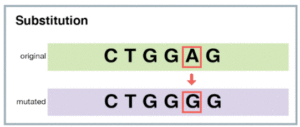 Substitution
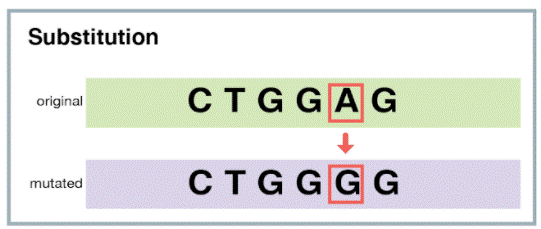
A substitution is a mutation that exchanges one base for another (i.e., a change in a single “chemical letter” such as switching an A to a G). Such a substitution could:
- change a codon to one that encodes a different amino acid and cause a small change in the protein produced. For example, sickle cell anemia is caused by a substitution in the beta-hemoglobin gene, which alters a single amino acid in the protein produced.
- change a codon to one that encodes the same amino acid and causes no change in the protein produced. These are called silent mutations.
- change an amino-acid-coding codon to a single “stop” codon and cause an incomplete protein. This can have serious effects since the incomplete protein probably won’t function.
 Insertion
Insertions are mutations in which extra base pairs are inserted into a new place in the DNA.
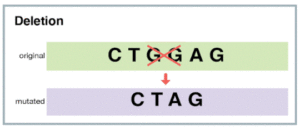
Deletion
Deletions are mutations in which a section of DNA is lost, or deleted.
 Frameshift
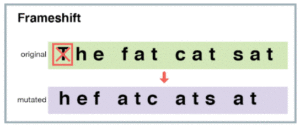
Since protein-coding DNA is divided into codons three bases long, insertions and deletions can alter a gene so that its message is no longer correctly parsed. These changes are called frameshifts.
For example, consider the sentence, “The fat cat sat.” Each word represents a codon. If we delete the first letter and parse the sentence in the same way, it doesn’t make sense.
In frameshifts, a similar error occurs at the DNA level, causing the codons to be parsed incorrectly. This usually generates truncated proteins that are as useless as “hef atc ats at” is uninformative.
There are other types of mutations as well, but this short list should give you an idea of the possibilities.