 UC Berkeley
The biological species concept defines a species as members of populations that actually or potentially interbreed in nature, not according to similarity of appearance. Although appearance is helpful in identifying species, it does not define species.
Appearance isn’t everything
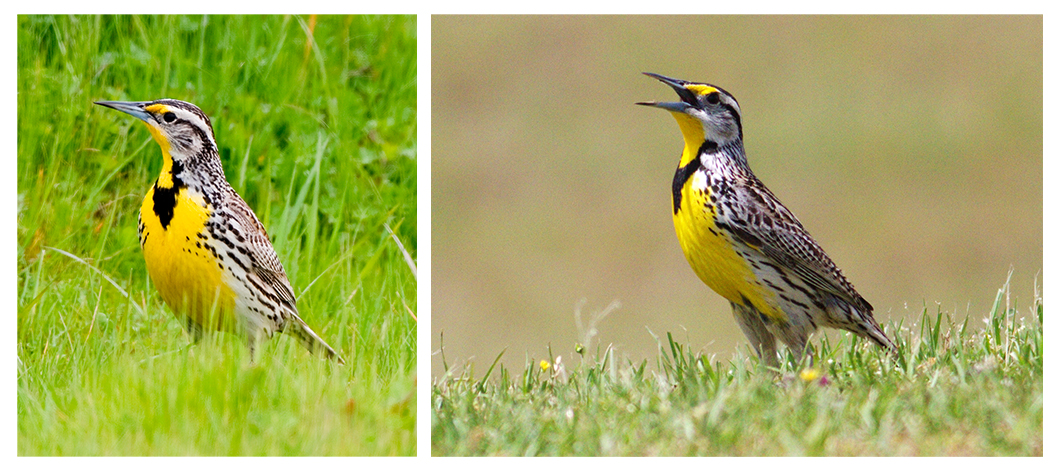
Organisms may appear to be alike and be different species. For example, Western meadowlarks (Sturnella neglecta) and Eastern meadowlarks (Sturnella magna) look almost identical to one another, yet do not interbreed with each other — thus, they are separate species according to this definition.
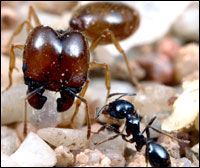
Organisms may look different and yet be the same species. For example, look at these ants. You might think that they are distantly related species. In fact, they are sisters—two ants of the species Pheidole barbata, fulfilling different roles in the same colony.
Many characteristics can vary within a single species. For example, the plant hydrangea may have pink “flowers” — they’re actually modified leaves — or blue “flowers.” But that doesn’t mean that we should classify the two forms as different species. In fact, you could cause a blue-“flowered” plant to become a pink-“flowered” plant just by changing the pH of the soil and the amount of aluminum taken up by the plant.
Adding to the problem
We already pointed out two of the difficulties with the biological species concept: what do you do with asexual organisms, and what do you do with organisms that occasionally form hybrids with one another? Other difficulties include:
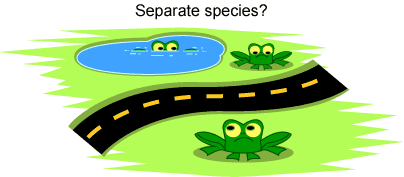
- What is meant by “potentially interbreeding?” If a population of frogs were divided by a freeway, as shown below, that prevented the two groups of frogs from interbreeding, should we designate them as separate species? Probably not — but how distantly separated do they have to be before we draw the line?
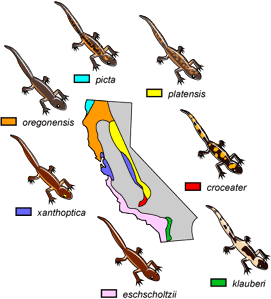
- Ring species are species with a geographic distribution that forms a ring and overlaps at the ends. The many subspecies of Ensatina salamanders in California exhibit subtle morphological and genetic differences all along their range. They all interbreed with their immediate neighbors with one exception: where the extreme ends of the range overlap in Southern California, E. klauberi and E. eschscholtzii do not interbreed. So where do we mark the point of speciation?
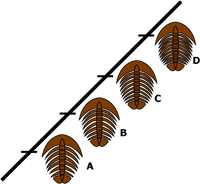
- Chronospecies are different stages in the same evolving lineage that existed at different points in time. Obviously, chronospecies present a problem for the biological species concept — for example, it is not really possible (or very meaningful!) to figure out whether a trilobite living 300 million years ago would have interbred with its ancestor living 310 million years ago. Consider the trilobite lineage below that evolved gradually over time. Should we consider trilobite A as a separate species from trilobite D, and if so, where should we divide the lineage into separate species?
Learn more about ring species: A closer look at a classic ring species: The work of Tom Devitt, a research profile.