 UC Berkeley
The biological species concept has its limitations (although it works well for many organisms and has been very influential in the growth of evolutionary theory). In order to address some of these limitations, many other “species concepts” have been proposed, such as:
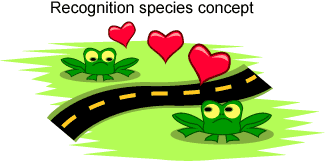 Recognition species concept: a species is a set of organisms that can recognize each other as potential mates. Even though these two frogs have been prevented from mating, the fact that they recognize each other as potential mates makes them the same species under the recognition species concept.
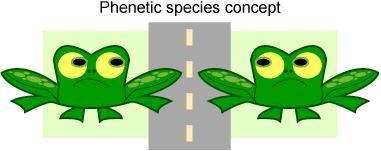 Phenetic species concept: a species is a set of organisms that are phenotypically similar and that look different from other sets of organisms. According to this concept, phenotypic similarity is all that matters in recognizing separate species. Since the frogs depicted here look the same — even though they are prevented from mating with each other — they would be considered the same species according to the phenetic species concept.
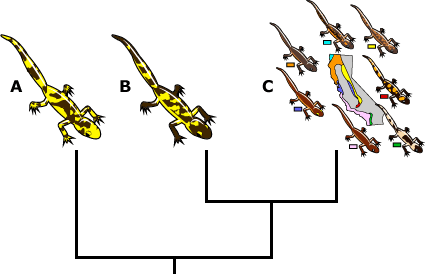 Phylogenetic species concept: a species is a “tip” on a phylogeny, that is, the smallest set of organisms that share an ancestor and can be distinguished from other such sets. Under this definition, a ring species is a single species that encompasses a lot of phenotypic variation. In this example, Ensatina salamander lineages A and B are separate species. Each has a common ancestor that individuals of other species do not. Even though it has diversified a lot, Lineage C is a single species, according to the phylogenetic species concept. None of the subspecies of Lineage C has a single common ancestor separate from the other subspecies.
A researcher’s choice of species concept often reflects his or her research focus. Making that decision requires the scientist to commit to a species concept. For most purposes and for communication with the general public, the biological species concept is used.
Learn more about ring species: A closer look at a classic ring species: The work of Tom Devitt, a research profile.