 UC Berkeley
Punctuated equilibrium is an important but often-misinterpreted model of how evolutionary change happens. Punctuated equilibrium does not:
- Suggest that Darwin’s theory of evolution by natural selection is wrong.
- Mean that the central conclusion of evolutionary theory, that life is old and organisms share a common ancestor, no longer holds.
- Negate previous work on how evolution by natural selection works.
- Imply that evolution only happens in rapid bursts.
Punctuated equilibrium predicts that a lot of evolutionary change takes place in short periods of time tied to speciation events. Here’s an example of how the model works:
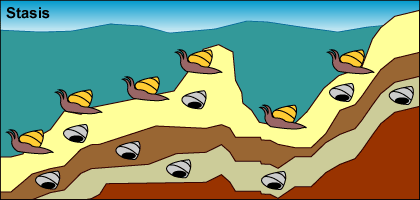
1. Stasis: A population of mollusks is experiencing stasis, living, dying, and getting fossilized every few hundred thousand years. Little observable evolution seems to be occurring judging from these fossils.
2. Isolation: A drop in sea level forms a lake and isolates a small number of mollusks from the rest of the population.
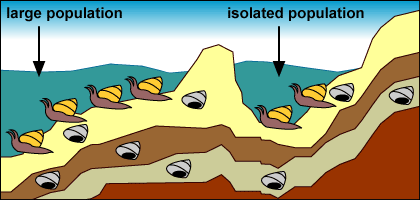
3. Strong selection and rapid change: The small, isolated population experiences strong selection and rapid change because of the novel environment and small population size: The environment in the newly formed lake exerts new selection pressures on the isolated mollusks. Also, their small population size means that genetic drift influences their evolution. The isolated population undergoes rapid evolutionary change. This is based on the model of peripatric speciation.
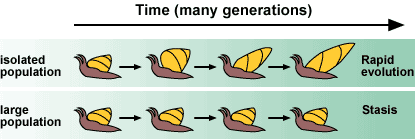
4. No preservation: No fossils representing transitional forms are preserved because of their relatively small population size, the rapid pace of change, and their isolated location.
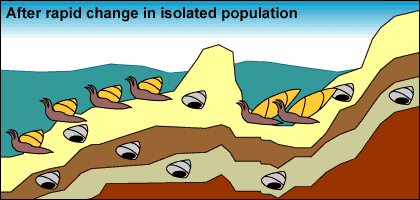
5. Reintroduction: Sea levels rise, reuniting the isolated mollusks with their sister lineage.
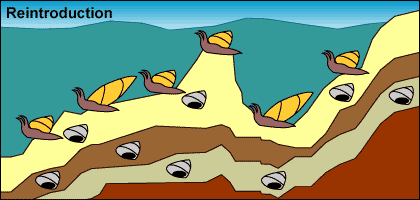
6. Expansion and stasis: The isolated population expands into its past range. Larger population size and a stable environment make evolutionary change less likely. The formerly isolated branch of the mollusk lineage may out-compete their ancestral population, causing it to go extinct.
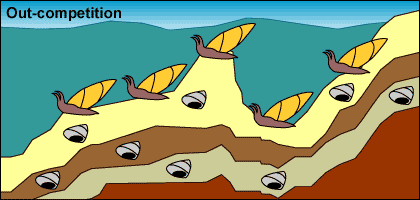
7. Preservation: Larger population size and a larger range move us back to step 1: stasis with occasional fossil preservation.
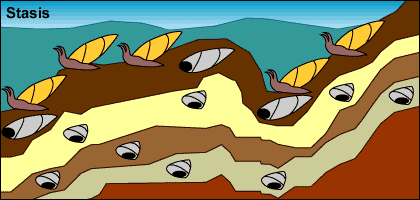
This process would produce the following pattern in the fossil record, in which evolution appears to happen in sharp jumps associated with speciation events:
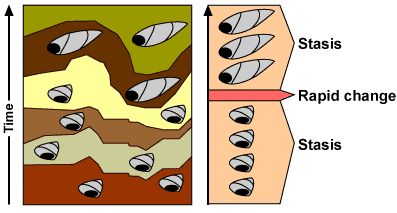
We observe similar patterns in the fossil records of many organisms. For example, the fossil records of certain foraminiferans (single-celled protists with shells) are consistent with a punctuated pattern.
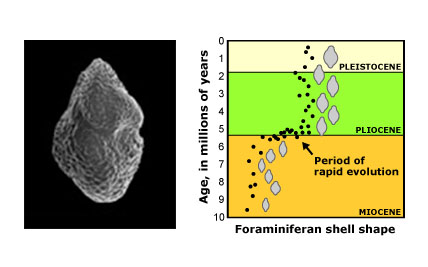
However, it is also important to note that we observe examples of gradual, non-punctuated, evolution in the fossil record too. The question that needs answering is: what are the relative frequencies of punctuated and gradual change?
Read more about peripatric speciation.