 UC Berkeley
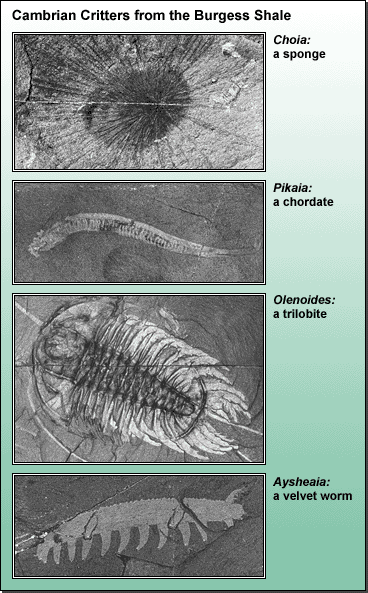
Around 530 million years ago, a wide variety of animals burst onto the evolutionary scene in an event known as the Cambrian explosion. In perhaps as few as 10 million years, marine animals evolved most of the basic body forms that we observe in modern groups. Among the organisms preserved in fossils from this time are relatives of crustaceans and starfish, sponges, mollusks, worms, chordates, and algae, exemplified by these taxa from the Burgess Shale.
An “explosion”?
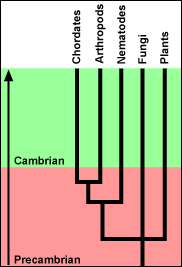
The term “explosion” may be a bit of a misnomer. Cambrian life did not evolve in the blink of an eye. The Cambrian was preceded by many millions of years of evolution, and many of the animal phyla actually diverged during the Precambrian.
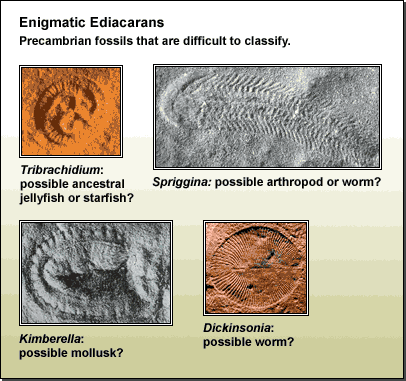
The animals of the Cambrian did not appear out of thin air. Animal fossils from before the Cambrian have been found. Roughly 575 million years ago, a strange group of animals known as Ediacarans lived in the oceans. Although, we don’t know much about the Ediacarans, the group may have included ancestors of the lineages that we identify from the Cambrian explosion.
Teach your students about the Cambrian explosion: Interactive investigation: The arthropod story, a web activity for grades 6-12.
Precambrian clade diagram after Wang, D.Y.-C., Kumar, S. & Hedges, S.B. (1999) Divergence time estimates for the early history of animal phyla and the origin of plants, animals and fungi. Proceedings of the Royal Society of London: Biological Sciences 266, no. 1415 (1999): 163