 UC Berkeley
By the 1700s, fossils had been inducted into the living world. Instead of being produced by rocks themselves, fossils were recognized as the remains of animals or plants. They looked too much like particular living species to be anything else. As the eighteenth century wore on, some fossils emerged that could not be tied so neatly to the known living species. Elephants, for example, had left fossils in Italy, where they could no longer be found. Yet elephants still lived in Africa, and naturalists assumed that other fossils had living counterparts of their own in some remote part of the world. But, at the end of the century, a French naturalist popularized an astonishing revelation: some species had actually vanished from the face of the Earth.
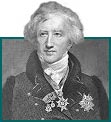
Georges Cuvier (1769-1832) joined the fledgling National Museum in Paris in 1795, and quickly became the world’s leading expert on the anatomy of animals. He then used that knowledge to interpret fossils with unprecedented insight. Legend has it that sometimes even a few fragments of bones were enough for him to reconstruct the complete anatomy of a previously unknown species with uncanny accuracy.
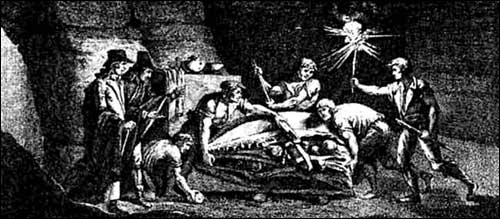
A few earlier naturalists, such as Buffon, had argued that species might become extinct. But for some people in Cuvier’s day, the idea of extinction was religiously troubling. If God had created all of nature according to a divine plan at the beginning of the world, it would seem irrational for Him to let some parts of that creation die off. If life consisted of a Great Chain of Being, extending from ocean slime to humans to angels, extinctions would remove some of its links.
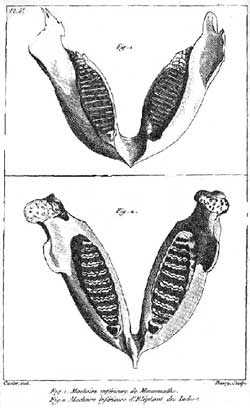
Cuvier carefully studied elephant fossils found near Paris. He discovered that their bones were indisputably distinct from those of living elephants in Africa and India. They were distinct even from fossil elephants in Siberia. Cuvier scoffed at the idea that living members of these fossil species were lurking somewhere on Earth, unrecognized—they were simply too big. Instead, Cuvier declared that they were separate species that had vanished. He later studied many other big mammal fossils and demonstrated that they too did not belong to any species alive today. The fossil evidence led him to propose that periodically the Earth went through sudden changes, each of which could wipe out a number of species.
Cuvier established extinctions as a fact that any future scientific theory of life had to explain. In Darwin‘s theory, species that did not adapt to changing environments or withstand the competition of other species faced annihilation. Darwin did not, however, accept all of Cuvier’s ideas on extinctions. Like Charles Lyell before him, he doubted that species went extinct in great “catastrophes.” Just as the planet’s geology changed gradually, so did its species become extinct gradually as new species were formed.
Background extinction and catastrophe
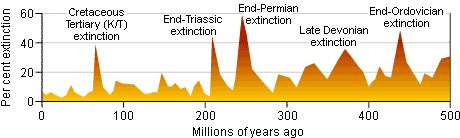
On this score, Cuvier has been somewhat vindicated. Perhaps 99% of all species that ever existed on Earth are now extinct. Most of those extinct species disappeared in a Darwinian trickle—what paleontologists call “background extinctions.” But several times over the past 600 million years, life has experienced “mass extinctions”, in which half or more of all species alive at the time disappeared in fewer than two million years—a blink of a geological eye. The causes may include asteroids, volcanoes, or relatively fast changes in sea level. These extinctions mark some of the great transitions in life, when new groups of species got the opportunity to take over the niches of old ones. Mammals, for example, only dominated the land after giant dinosaurs vanished 65 million years ago in the Cretaceous-Tertiary extinction. We humans, in other words, are the children of extinctions.