 UC Berkeley
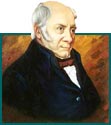
At the end of the eighteenth century, geologists still had a confused perception of the rocks they studied. Steno had shown in the 1600s that rocks could form in horizontal layers over time, which might later be carved away to expose old rock once again. But geologists had great difficulty reconstructing the original order of the layers by looking at the surviving rock. That began to change around 1800, thanks in large part to an obscure British canal surveyor named William Smith (above left).
Relative dating of rocks using fossils
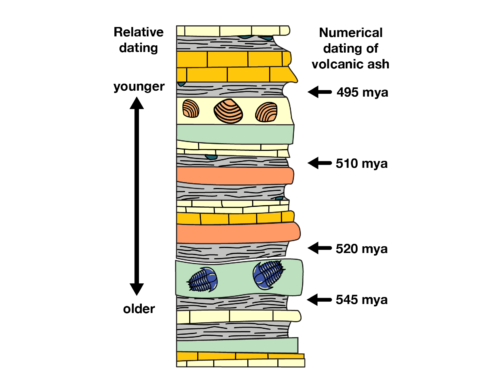 Smith, who had little formal education, traveled throughout England as a surveyor and spent six years supervising the digging of the Somerset Canal in southwestern England. Along the way he became well acquainted with the rocks through which he cut the canals. He was surprised to find that the fossils in the layers often were arranged in the same distinctive order from the bottom to the top of the rocks. And as he traveled across England, he discovered the same sequences of fossils in rock layers. Each type of animal, he realized, had a widespread existence for a particular span of time, a span that partially overlapped with that of other animals. That made it possible for Smith to recognize the order in which rocks had been formed throughout much of England.
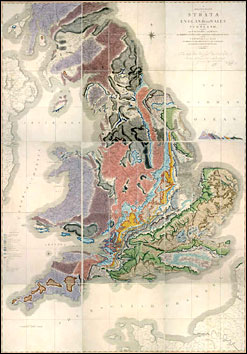
Smith began to make the first geological map of England. It took sixteen years to publish it, but the geologists of his day, drawn from the upper classes, spurned this unpolished pioneer. For years after publishing his map, Smith lived in anonymous poverty. Only in 1831 did a new generation of geologists appreciate Smith’s contribution. In that year the Geological Society of London awarded him the Wollaston Medal, their highest prize.
Triggering a revolution
By the time Smith received the Wollaston Medal, his map had helped trigger a revolution in geology. Geologists used his methods to discover even older geological formations whose outcrops were scattered across England. Meanwhile on the continent, Georges Cuvier and Alexandre Brongniart used much the same method to decipher the rocks around Paris. It became inescapably clear to geologists that Earth and its life were far older than a few thousand years.
Chapters in the history of life
Their maps also allowed them to organize the history of life into a series of chapters, from the Cambrian with its bizarre invertebrates to the dinosaurs of the Jurassic to the mammals of more recent times. Life in each stage was a unique collection of species. Exactly how it had changed from one stage to the next was a matter of fierce debate. Adam Sedgwick, a geologist at Cambridge University, suggested that God somehow brought new forms of life into existence at the beginning of each geological age. Richard Owen, England’s leading anatomist at the time, argued that over time God created new species by modifying a basic anatomical idea, an “archetype.” Darwin, finally, recognized that fossils recorded the evolution and extinction of life, as natural selection and other natural factors changed species through time.