 UC Berkeley
With the fall of Ernst Haeckel’s Biogenetic Law in the 1920s, the evolutionary study of embryos receded into the intellectual backwaters for decades. Haeckel’s notion that ontogeny recapitulates phylogeny was deeply flawed, but it was at least straightforward. The few researchers who tried to carry on the study of embryos and evolution proposed a confusing jumble of different kinds of evolutionary change — for which they invented a jumble of hideously confusing names such as paedomorphosis, proterogenesis, and phyloembryogenesis. Most embryologists chose instead to focus on understanding how embryos develop — a formidable question in itself — without thinking much about the evolutionary implications of their work. Meanwhile, evolutionary biologists concentrated much of their efforts on the blossoming field of genetics.
Evo meets devo again

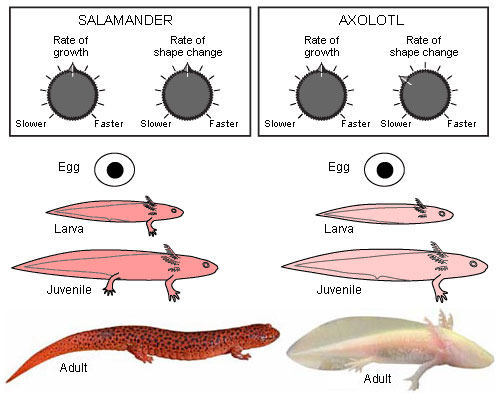
More than anyone else, the Harvard paleontologist Stephen Jay Gould (left) drew attention back to embryos as evolutionary time capsules. In his landmark 1977 book Ontogeny and Phylogeny, Gould documented the history of scientific research that had led to so much confusion. But he also demonstrated that the wealth of cases could be organized by some simple principles. Imagine that the timing of development is controlled by two knobs like you’d find on a radio. One controls the rate at which an organism grows. The other controls the rate at which it changes shape over time. Random mutation may end up changing the settings of each knob, thereby speeding up or slowing down the rate at which a species’ embryos develop. These kinds of adjustments can alter the entire body of an organism, or individual organs.
Genetic triggers for developmental change
These changes in timing, known collectively as heterochrony, have proved to be numerous and significant. But Gould knew very well that the ultimate explanation for heterochrony would be found not in metaphorical radio knobs but in the genes whose effects those knobs represented. Around the time that Ontogeny and Phylogeny was published, biologists began to isolate genes involved in development for the first time. Since then they’ve gotten a much better look at how these genes send signals that trigger other genes, and how they induce embryonic cells to proliferate, die off, crawl to new locations or stick together.
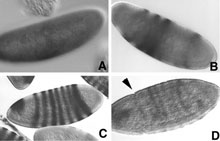
At the dawn of this new scientific age, Gould predicted that heterochrony and similar evolutionary changes would not be directed by the genes that actually build various body parts. Instead, the genes that regulate other genes would hold the key to the evolution of embryos. His prediction has now been borne out. In 2000, for example, Junhyong Kim and his fellow Yale biologists compared the timing at which a crucial developmental gene (see photos, right) became active in the fruit fly, Drosophila melanogaster, and two closely related species, D. simulans and D. pseudoobscura. They found that the gene started to make its proteins 24 minutes later in D. pseudoobscura than D. melanogaster. Meanwhile, D. simulans gets a head start: its gene becomes active 14 minutes earlier. And that change led to differences in their anatomy — even though the developmental gene itself is identical in all three species.
As scientists have begun to isolate these regulatory genes, they’ve been shocked at how powerful they are and how long they’ve been in power over the course of evolution.
Read more about the role of developmental changes in Evolution 101. And learn more about Hox genes.