 UC Berkeley
Because natural selection can produce amazing adaptations, it’s tempting to think of it as an all-powerful force, urging organisms on, constantly pushing them in the direction of progress — but this is not what natural selection is like at all.
First, natural selection is not all-powerful; it does not produce perfection. It’s all about getting genes into the next generation, and if your genes are “good enough” to do that, you don’t have to be perfect. This should be clear just by looking around us: human populations carry genes that cause disease, plants may not have the genes to survive a drought, a predator may not be quite fast enough to catch her prey every time she is hungry. No population or organism is perfectly adapted.
Second, it’s more accurate to think of natural selection as a process rather than as a guiding hand. Natural selection is the simple result of variation, differential reproduction, and heredity — it is mindless and mechanistic. It has no goals; it’s not striving to produce “progress” or a balanced ecosystem.

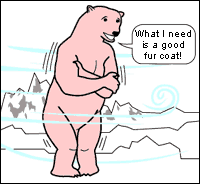
This is why “need,” “try,” and “want” are not very accurate words when it comes to explaining evolution. The population or individual does not “want” or “try” to evolve, and natural selection cannot try to supply what an organism “needs.” Natural selection just selects among whatever variations exist in the population. The result is evolution.
At the opposite end of the scale, natural selection is sometimes interpreted as a completely random process. This is also a misconception. The genetic variation that occurs in a population because of mutation is random — but selection acts on that variation in a very non-random way: genetic variants that aid survival and reproduction are much more likely to become common than variants that don’t. Natural selection is NOT random!
Read more about how natural selection does not produce perfectly engineered traits or perfect populations (i.e., populations with no deleterious genes).
Read about misinterpretations of natural selection in context:
- Hybrid sharks aren’t “trying” to adapt, a news brief with discussion questions.
Teach your students about natural selection:
- Clipbirds, a classroom activity for grades 6-12.
- Breeding bunnies, a classroom activity for grades 9-12.
Find additional lessons, activities, videos, and articles that focus on natural selection.
Reviewed and updated, June 2020.