 UC Berkeley

Ronald Fisher and his colleagues set Darwin’s concept of natural selection on a new foundation of genetics. They left an equally major project open for later biologists: to explain in the language of genes, what species are and how they originate. The answer only began to emerge in the 1930s, thanks in large part to the work of a Soviet-born geneticist named Theodosius Dobzhansky (right).
Dobzhansky, who emigrated to the United States in 1928, worked in Thomas Hunt Morgan’s “Fly Room,” where mutations were being studied closely for the first time. He also paid careful attention to the work of population geneticists such as Sewall Wright, who were showing how the size of a population affects the rate at which a mutation can spread. Dobzhansky was interested in discovering the genetics that determined the differences between populations of a species.
Genetically variable populations
At the time, most biologists assumed that all of the members of any given species had practically identical genes. But these were assumptions bred in the lab. Dobzhansky began analyzing the genes of wild fruit flies, traveling from Canada to Mexico to catch members of the species Drosophila pseudoobscura. He found that different populations of D. pseudoobscura did not have identical sets of genes. Each population of fruit flies he studied bore distinctive markers in its chromosomes that distinguished it from other populations.
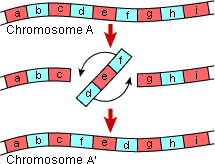
If there was no standard set of genes that distinguished a species, what kept species distinct from each other? The answer, Dobzhansky correctly realized, was sex. A species is simply a group of animals or plants that reproduces primarily among themselves. Two animals belonging to different species are unlikely to mate, and even if they do, they will rarely produce viable hybrids. Dobzhansky ran experiments on fruit flies that demonstrated that this incompatibility is caused by specific genes carried by one species that clash with the genes from another species.
Making a new species
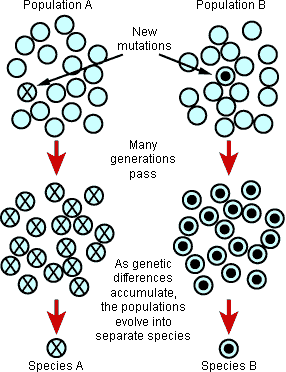 In 1937, Dobzhansky published these results in a landmark book, Genetics and the Origin of Species. In it, he sketched out an explanation for how species actually came into existence. Mutations crop up naturally all the time. Some mutations are harmful in certain circumstances, but a surprising number have no effect one way or the other. These neutral changes appear in different populations and linger, creating variability that is far greater than anyone had previously imagined.
This variability serves as the raw material for making new species. If the members of a population of flies should breed among themselves more than with other members of the species, their genetic profile would diverge. New mutations would arise in the isolated population, and natural selection might help them to spread until all the flies carried them. But because these isolated flies were only breeding within their own population, the mutations could not spread to the rest of the species. The isolated population of flies would become more and more genetically distinct. Some of their new genes would turn out to be incompatible with the genes of flies from outside their own population.
If this isolation lasted long enough, Dobzhansky argued, the flies might lose the ability to interbreed completely. They might simply become unable to mate with the other flies successfully, or their hybrid offspring might become sterile. If the flies were now to come out of their isolation, they could live alongside the other insects but still continue mating only among themselves. A new species would be born.
The Modern Synthesis
Dobzhansky’s ability to combine genetics and natural history attracted many other biologists to join him in the effort to find a unified explanation of how evolution happens. Their combined work, known as “The Modern Synthesis,” brought together genetics, paleontology, systematics, and many other sciences into one powerful explanation of evolution, showing how mutations and natural selection could produce large-scale evolutionary change. The Modern Synthesis certainly did not bring the study of evolution to an end, but it became the foundation for future research.
Learn more about The Modern Synthesis or genetic variation and ethnicity.