 UC Berkeley
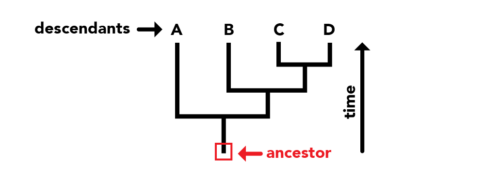
Understanding a phylogeny is a lot like reading a family tree. The root of the tree represents the ancestral lineage, and the tips of the branches represent the descendants of that ancestor. As you move from the root to the tips, you are moving forward in time.
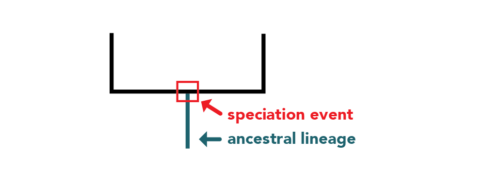
When a lineage splits (speciation), it is represented as branching on a phylogeny. When a speciation event occurs, a single ancestral lineage gives rise to two or more daughter lineages.
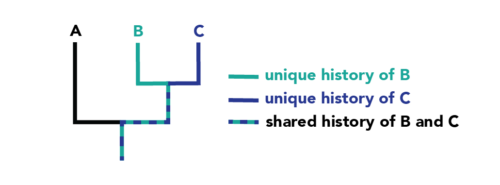
Phylogenies trace patterns of shared ancestry between lineages. Each lineage has a part of its history that is unique to it alone and parts that are shared with other lineages.
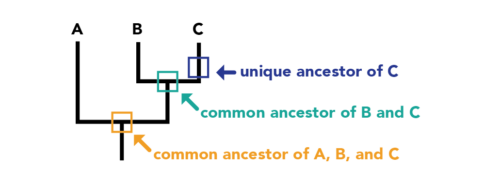
Similarly, each lineage has ancestors that are unique to that lineage and ancestors that are shared with other lineages — common ancestors.
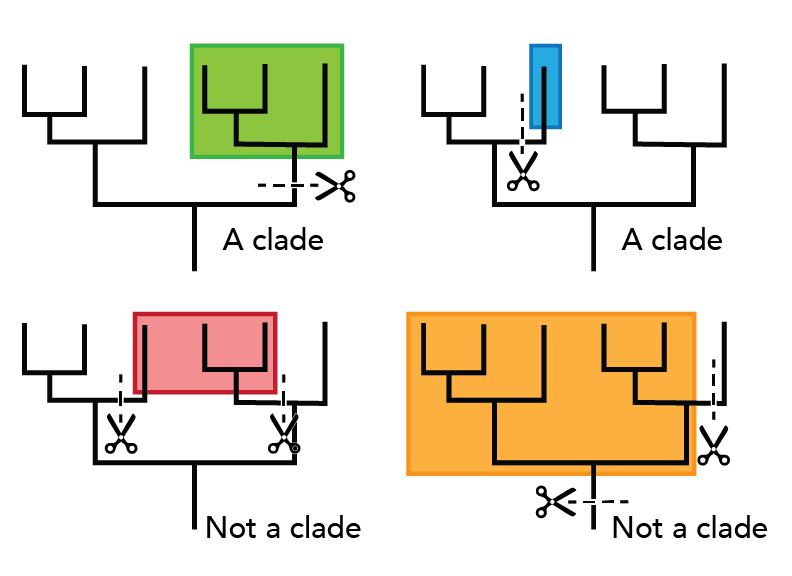
A clade is a grouping that includes a common ancestor and all the descendants (living and extinct) of that ancestor. Using a phylogeny, it is easy to tell if a group of lineages forms a clade. Imagine clipping a single branch off the phylogeny — all of the organisms on that pruned branch make up a clade.
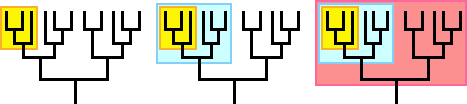
Clades are nested within one another — they form a nested hierarchy. A clade may include many thousands of species or just a few. Some examples of clades at different levels are marked on the phylogenies below. Notice how clades are nested within larger clades.
So far, we’ve said that the tips of a phylogeny represent descendent lineages. Depending on how many branches of the tree you are including however, the descendants at the tips might be different populations of a species, different species, or different clades, each composed of many species.
Get the basics on understanding evolutionary trees in this primer.
In some phylogenies, more than two daughter lineages arise from a single ancestral lineage. Find out how to interpret these trees.
Teach your students about evolutionary relationships and phylogenetics:
- What did T. rex taste like?, a web activity for grades 6-12
Find additional lessons, activities, videos, and articles that focus on phylogenetics.