 UC Berkeley
Sickle cell anemia is a genetic disease with severe symptoms, including pain and anemia. The disease is caused by a mutated version of the gene that helps make hemoglobin — a protein that carries oxygen in red blood cells. People with two copies of the sickle cell gene have the disease. People who carry only one copy of the sickle cell gene do not have the disease, but may pass the gene on to their children.
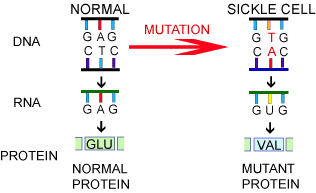
The mutations that cause sickle cell anemia have been extensively studied and demonstrate how the effects of mutations can be traced from the DNA level up to the level of the whole organism. Consider someone carrying only one copy of the gene. She does not have the disease, but the gene that she carries still affects her, her cells, and her proteins:
- There are effects at the DNA level
- There are effects at the protein level
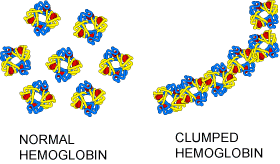 Normal hemoglobin (left) and hemoglobin in sickled red blood cells (right) look different; the mutation in the DNA slightly changes the shape of the hemoglobin molecule, allowing it to clump together.
 -
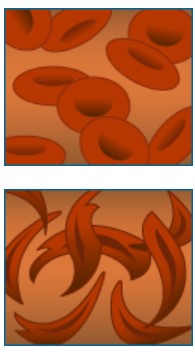
Normal red blood cells (top) and sickle cells (bottom). There are effects at the cellular level
When red blood cells carrying mutant hemoglobin are deprived of oxygen, they become “sickle-shaped” instead of the usual round shape (see picture). This shape can sometimes interrupt blood flow. - There are negative effects at the whole organism level
Under conditions such as high elevation and intense exercise, a carrier of the sickle cell allele may occasionally show symptoms such as pain and fatigue. - There are positive effects at the whole organism level
Carriers of the sickle cell allele are resistant to malaria, because the parasites that cause this disease are killed inside sickle-shaped blood cells.
This is a chain of causation. What happens at the DNA level propagates up to the level of the complete organism. This example illustrates how a single mutation can have a large effect, in this case, both a positive and a negative one. But in many cases, evolutionary change is based on the accumulation of many mutations, each having a small effect. Whether the mutations are large or small, however, the same chain of causation applies: changes at the DNA level propagate up to the phenotype.
Read more about how mutations factored into the history of evolutionary thought.
Learn more about mutation in context:
Find lessons, activities, videos, and articles that focus on mutation.