 UC Berkeley
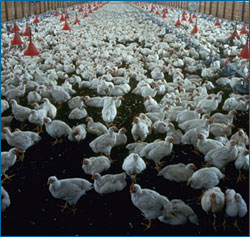
“Just say no to drugs” was the message sent to chicken farmers in July of 2005 when the FDA banned the use of the antibiotic Baytril in poultry production. Citing concerns for human health, the FDA will no longer allow poultry producers to give their chickens, turkeys, and ducks Baytril-laced water to treat and prevent respiratory infections in the birds. That move reinforced the actions of McDonald’s, Wendy’s, and other fast food giants that have, in recent years, refused to buy chicken treated with Baytril and other selected drugs. Even the pork industry is getting in on the act. In August, Smithfield Foods Inc., the company likely to have supplied that glazed ham for your Sunday supper, announced that it would stop treating its pigs with selected antibiotics for growth-promotion purposes.
Where's the evolution?
But how does using an antibiotic on chickens and pigs affect human health, and what does this all have to do with evolution? At issue is the evolution of antibiotic resistant bacteria.
When a farmer treats a chicken flock with the antibiotic Baytril, it kills most of the bacteria responsible for the respiratory infection — but it also kills many of the campylobacter bacteria that naturally live in the chickens’ guts. Ever take an antibiotic for strep throat and wind up with an upset stomach? You’ve done the same thing — killed most of your naturally-occurring gut bacteria!
Here’s the problem: not all of the campylobacter are killed, and the few that survive probably carry a mutation that makes them resistant to Baytril. These resistant campylobacter then pass that mutation on to their offspring as they multiply. Hence, natural selection causes the evolution of Baytril-resistant campylobacter bacteria. If campylobacter get into your body (perhaps through contaminated chicken meat), you may wind up with food-poisoning. With normal campylobacter, you could just take the antibiotic Cipro to clear up the infection — but since Baytril and Cipro are similar antibiotics, Baytril-resistant bacteria are also likely to be Cipro-resistant…and, voila, you end up with a terrible case of food-poisoning and no useful drug to treat it.
The potential ramifications become even more frightening when you consider the fact that bacteria have the unusual ability to pass genes back and forth between species in a process called horizontal transfer. Cipro is one of the few antibiotics used to fight the anthrax bacterium. If a campylobacter passed its Cipro-resistance gene on to an anthrax bacterium, we could end up facing a frightening “super-bug.”
The evolution of antibiotic resistant bacteria is a serious concern — and it is not just limited to Baytril. Many human antibiotics have sister-drugs that are freely used on livestock in copious amounts. The presence of these antibiotics sets the stage for the evolution of resistant bacteria in any environment: in the animals themselves or in the soil and water contaminated by the antibiotic.
In 2005, the FDA banned the preventative use of the antibiotic Baytril in poultry production. This move was aimed at slowing the evolution of drug resistant bacteria that threaten human health. Exposure to Baytril is likely to select for strains of bacteria resistant to the critical human antibiotic Cipro. However, since this first step, the FDA has taken no further action curbing the use of other antibiotics in livestock — though tens of millions of pounds of these drugs are used on U.S. livestock and tens of thousands of people die as the result of antibiotic resistant infections each year.
Now, Congress and the Administration may be picking up where the FDA left off. In March of this year, a bill to limit the use of antibiotics in livestock feed was introduced in the House of Representatives. And in July, the Principal Deputy Commissioner of Food and Drugs came out in favor of the new legislation — which would phase out the preventative use of medically important antibiotics in livestock and require that new animal antibiotics be evaluated against the same criteria. Under the new legislation, the drugs could still be used to treat sick animals. If the bill goes into effect, it would recognize the evolutionary consequences of our actions and, in so doing, help modern medicine fight the battle against drug resistant pathogens.
In December of 2013, the U.S. Food and Drug Administration announced a major step to curb the indiscriminate use of antibiotics on livestock and help rein in the evolution of antibiotic resistant bacteria strains. Over the next three years, the FDA will ask animal pharmaceutical companies to label antibiotics so that it is clear that the drugs should not be used to boost animal growth. In a further step, these drugs will no longer be available over the counter but will require the oversight of a veterinarian when they are used to prevent or treat disease. Twenty-five of 26 antibiotic manufacturers have signed on to the agreement. These measures are expected to reduce the prevalence of antibiotics in the environment and, hence, reduce the strength of natural selection favoring resistant bacterial strains.
Until recently, the task of curbing unnecessary antibiotic use in animals had fallen mainly to the FDA and advocacy groups — but that changed this year when the President got involved. In the fall, the White House announced a strategy to address antibiotic overuse, and in June, President Obama met with groups from the food industry, restaurants, and medical fields to discuss the problem. Because restaurant chains like McDonald’s are beginning to request antibiotic-free meat, some major livestock providers, including Foster Farms, Perdue, and Tyson, have already made plans to discontinue the use of antibiotics important for treating humans in their livestock. The movement to reduce the use of antibiotics in meat production — and hence, slow the evolution of antibiotic resistant bacterial strains — appears to be gaining momentum.
Primary literature:
- Gaunt, P.N., and Piddock, L.J.V. (1996). Ciprofloxacin resistant Campylobacter spp. in humans: An epidemiological and laboratory study. Journal of Antimicrobial Chemotherapy 37:747-757. Read it »
News articles:
- A typical news item on this topic from the Associated Press
- An excellent summary of the FDA's decision and the science behind it originally published in the Wall Street Journal
- An article covering the debate over uses of antibiotics on livestock from PBS
- A scientific perspective on the issue of antibiotic resistance, originally published in Scientific American in 1998
- Another case of antibiotic resistance in the news from Reuters Health
Understanding Evolution resources:
- What role did evolution play in the decision to ban the use of Baytril in poultry?
- Why do antibiotic resistant bacteria in chickens threaten human health?
- Compare bacterial evolution to human evolution. How are they similar, and how are they different?
- Compare and contrast the role of natural selection in producing antibiotic resistant bacteria and in producing a dangerous strain of the avian flu (see Evolution and the avian flu).
- What strategies can help prevent the evolution of antibiotic resistant bacteria?
- Teach about natural selection. In this classroom activity for grades 9-12, students experience one mechanism for evolution through a simulation that models the principles of natural selection and helps answer the question: How might biological change have occurred and been reinforced over time?
- Teach about another application of evolutionary theory in medicine. In this classroom activity for grades 9-12, students learn why evolution is at the heart of a world health threat by investigating the increasing problem of antibiotic resistance in menacing diseases such as tuberculosis.
- Citing human threat, U.S. bans a poultry drug. (2005, July 29). The New York Times, p. A17.
- FDA. (2013, Dec 11). FDA takes significant steps to address antimicrobial resistance. Retrieved May 27, 2014 from the U.S. Food and Drug Administration
- FDA. (2014, March 26). FDA update on animal pharmaceutical industry response to Guidance #213. Retrieved May 27, 2014 from the U.S. Food and Drug Administration
- FDA bans some antibiotics in poultry. Talk of the nation/Science Friday. Ira Flatow (anchor). National Public Radio. (2005, August 19).
- Gardiner, H. (2009, July 14). Administration seeks to restrict antibiotics in livestock. The New York Times, p A18.
- Mellon, M. (2009, July 13). Testimony Before the House Committee on Rules On The Preservation of Antibiotics for Medical Treatment Act H.R. 1549. Retrieved July 29, 2009 from Union of Concerned Scientists.
- Pork Barrel. (2005, August 11). Nature 436:775.
- Sharfstein, J. M. (2009, July 13). Testimony of Joshua M. Sharfstein M.D., Principal Deputy Commissioner of Food and Drugs, Food and Drug Administration, Hearing on H.R. 1549, "Preservation of Antibiotics for Medical Treatment Act of 2009." Retrieved July 29, 2009 from U.S. House of Representatives Committee on Rules.
- Tavernise, S. (2015, June 2). White House meeting elicits pledges to reduce antibiotic use. Retrieved June 29, 2015 from The New York Times.
- Union of Concerned Scientists. (2004, April 7). Hogging it!: estimates of antimicrobial abuse in livestock (2001). Retrieved July 29, 2009 from Union of Concerned Scientists.