 UC Berkeley
The process of evolution produces a pattern of relationships between species. As lineages evolve and split and modifications are inherited, their evolutionary paths diverge. This produces a branching pattern of evolutionary relationships.
By studying inherited species’ characteristics and other historical evidence, we can reconstruct evolutionary relationships and represent them on a “family tree,” called a phylogeny. The phylogeny you see below represents the basic relationships that tie all life on Earth together.
This tree, like all phylogenetic trees, is a hypothesis about the relationships among organisms. It illustrates the idea that all of life is related. As shown below, we can zoom in on particular branches of the tree to explore the phylogeny of particular lineages, for example, the eukaryotes. And then we can zoom in even further to examine some of the major lineages within Eukaryota, for example, the Opisthokonta…and so on.
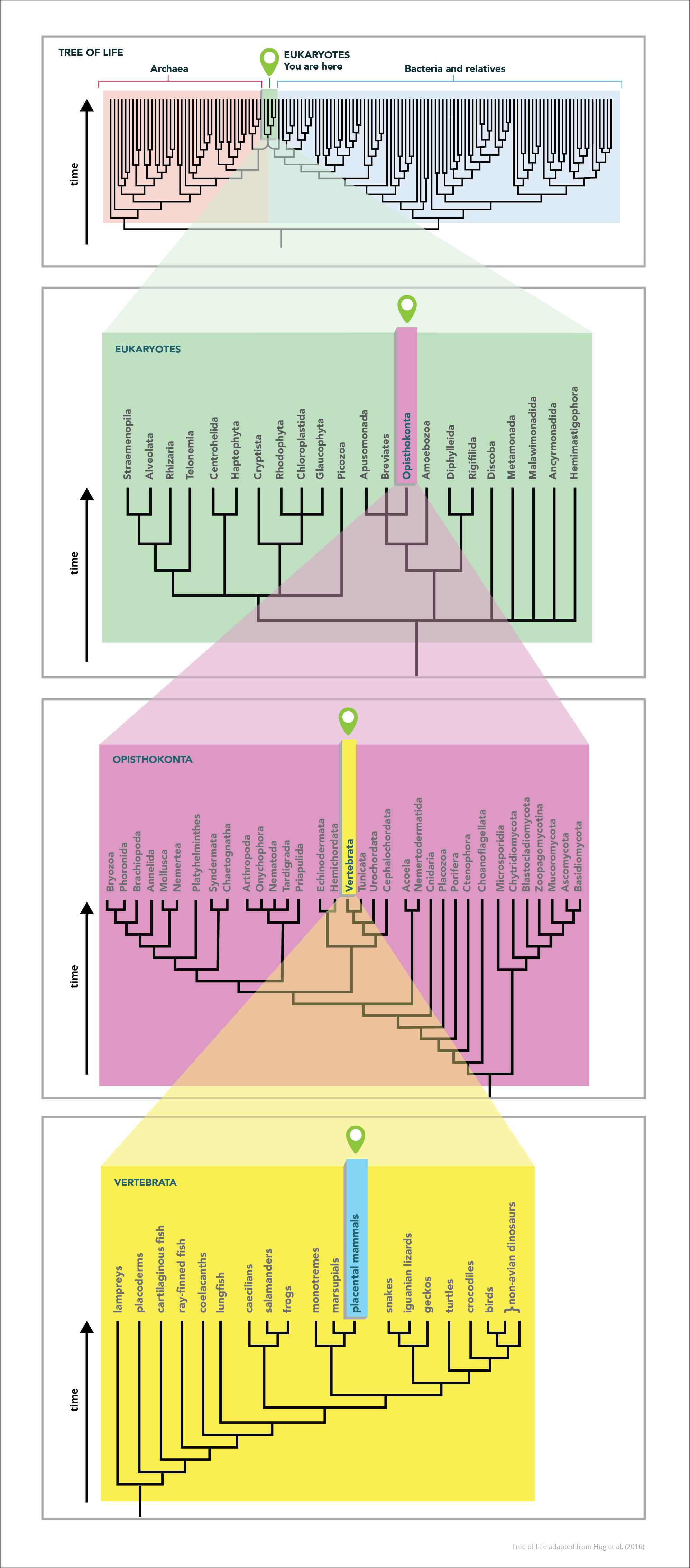
The tree is supported by many lines of evidence, but it is probably not flawless. Scientists constantly reevaluate hypotheses and compare them to new evidence. As scientists gather even more data, they may revise these particular hypotheses, rearranging some of the branches on the tree. For example, evidence discovered in the last 50 years suggests that birds are dinosaurs, which required adjustment to several “vertebrate twigs.”
Get the basics on understanding evolutionary trees in this primer.
Teach your students about evolutionary relationships and phylogenetics:
- What did T. rex taste like?, a web activity for grades 6-12
Find additional lessons, activities, videos, and articles that focus on phylogenetics.