 UC Berkeley
An adaptation is a feature that arose and was favored by natural selection for its current function. Adaptations help an organism survive and/or reproduce in its current environment.
Adaptations can take many forms: a behavior that allows better evasion of predators, a protein that functions better at body temperature, or an anatomical feature that allows the organism to access a valuable new resource — all of these might be adaptations. Many of the things that impress us most in nature are thought to be adaptations.
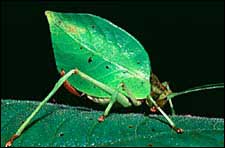
Mimicry of leaves by insects is an adaptation for evading predators. This example is a katydid from Costa Rica.
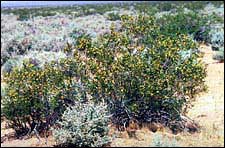
The creosote bush is a desert-dwelling plant that produces toxins that prevent other plants from growing nearby, thus reducing competition for nutrients and water.
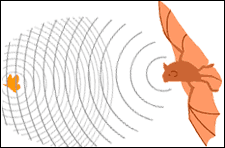 Echolocation in bats is an adaptation for catching insects.
So what’s not an adaptation? The answer: a lot of things. One example is vestigial structures. A vestigial structure is a feature that was adaptive for the organism’s ancestor, but that evolved to be non-functional because the organism’s environment changed.
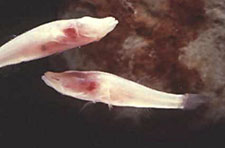
Fish species that live in completely dark caves have vestigial, non-functional eyes. When their sighted ancestors ended up living in caves, there was no longer any natural selection that maintained the function of the fishes’ eyes. So fish with better sight no longer out-competed fish with worse sight. Today, these fish still have eyes — but they are not functional and are not an adaptation; they are just the by-products of the fishes’ evolutionary history.
Many of the features of organisms that most impress us are adaptations. Learn about what evidence biologists look for to determine if a trait is an adaption and common misconceptions regarding adaptations. However, not all traits of organisms are adaptations. Read more about the sorts of traits that are not adaptations and one particular type of non-adaptation, exaptation.
Learn more about adaptations in context:
- Biological warfare and the coevolutionary arms race, a case study.
- Quick bites and quirky adaptations, a news brief with discussion questions.
- High-altitude adaptations: The work of Emilia Huerta-Sánchez, a research profile.
- Coping with climate change, a news brief with discussion questions.
Teach your students about adaptations with Form and function, a classroom activity for grades K-2.
Find additional lessons, activities, videos, and articles that focus on adaptations.
Reviewed and updated, June 2020.