 UC Berkeley
We’ve defined microevolution as a change in gene frequency in a population and a population as a group of organisms that share a common gene pool — like all the individuals of one beetle species living on a particular mountaintop.
Imagine that you go to the mountaintop this year, sample these beetles, and determine that 80% of the genes in the population are for green coloration and 20% of them are for brown coloration. You go back the next year, repeat the procedure, and find a new ratio: 60% green genes to 40% brown genes.
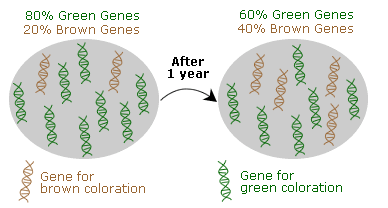
You have detected a microevolutionary pattern: a change in gene frequency. A change in gene frequency over time means that the population has evolved.
The big question is, how did it happen?
Learn more about gene frequency in context: Got lactase?, a news brief with discussion questions.
Teach your students about gene frequency and changes in gene frequency:
Find additional lessons, activities, videos, and articles that focus on gene frequency.