 UC Berkeley
Speciation in action?
In the summer of 1995, at least 15 iguanas survived Hurricane Marilyn on a raft of uprooted trees. They rode the high seas for a month before colonizing the Caribbean island, Anguilla. These few individuals were perhaps the first of their species, Iguana iguana, to reach the island. If there were other intrepid Iguana iguana colonizers of Anguilla, they died out before humans could record their presence.
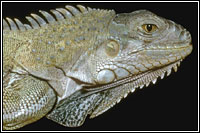
Evolutionary biologists would love to know what happens next: will the colonizing iguanas die out, will they survive and change only slightly, or will they become reproductively isolated from other Iguana iguana and become a new species? We could be watching the first steps of an allopatric speciation event, but in such a short time we can’t be sure.
A plausible model
We have several plausible models of how speciation occurs — but of course, it’s hard for us to get an eye-witness account of a natural speciation event since most of these events happened in the distant past. We can figure out that speciation events happened and often when they happened, but it’s more difficult to figure out how they happened. However, we can use our models of speciation to make predictions and then check these predictions against our observations of the natural world and the outcomes of experiments. As an example, we’ll examine some evidence relevant to the allopatric speciation model.
Scientists have found a lot of evidence that is consistent with allopatric speciation being a common way that new species form:
- Geographic patterns: If allopatric speciation happens, we’d predict that populations of the same species in different geographic locations would be genetically different. There are abundant observations suggesting that this is often true. For example, many species exhibit regional “varieties” that are slightly different genetically and in appearance, as in the case of the Northern Spotted Owl and the Mexican Spotted Owl. Also, ring species are convincing examples of how genetic differences may arise through reduced gene flow and geographic distance.
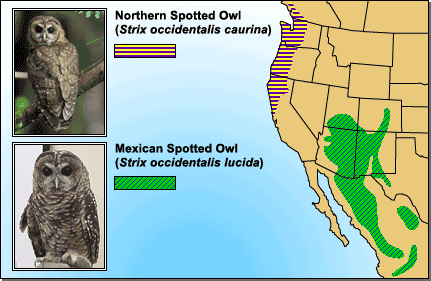
Spotted owl subspecies living in different geographic locations show some genetic and morphological differences. This observation is consistent with the idea that new species form through geographic isolation. Northern spotted owl photo by John and Karen Hollingsworth courtesy of U.S. Fish and Wildlife Service; Mexican spotted owl photo by Diane Knudsen courtesy of U.S. Fish and Wildlife Service. - Experimental results: The first steps of speciation have been produced in several laboratory experiments involving “geographic” isolation. For example, Diane Dodd examined the effects of geographic isolation and selection on fruit flies. She took fruit flies from a single population and divided them into separate populations living in different cages to simulate geographic isolation. Half of the populations lived on maltose-based food, and the other populations lived on starch-based foods. After many generations, the flies were tested to see which flies they preferred to mate with. Dodd found that some reproductive isolation had occurred as a result of the geographic isolation and selection for different food sources in the two environments: “maltose flies” preferred other “maltose flies,” and “starch flies” preferred other “starch flies.” Although, we can’t be sure, these preference differences probably existed because selection for using different food sources also affected certain genes involved in reproductive behavior. This is the sort of result we’d expect, if allopatric speciation were a typical mode of speciation.
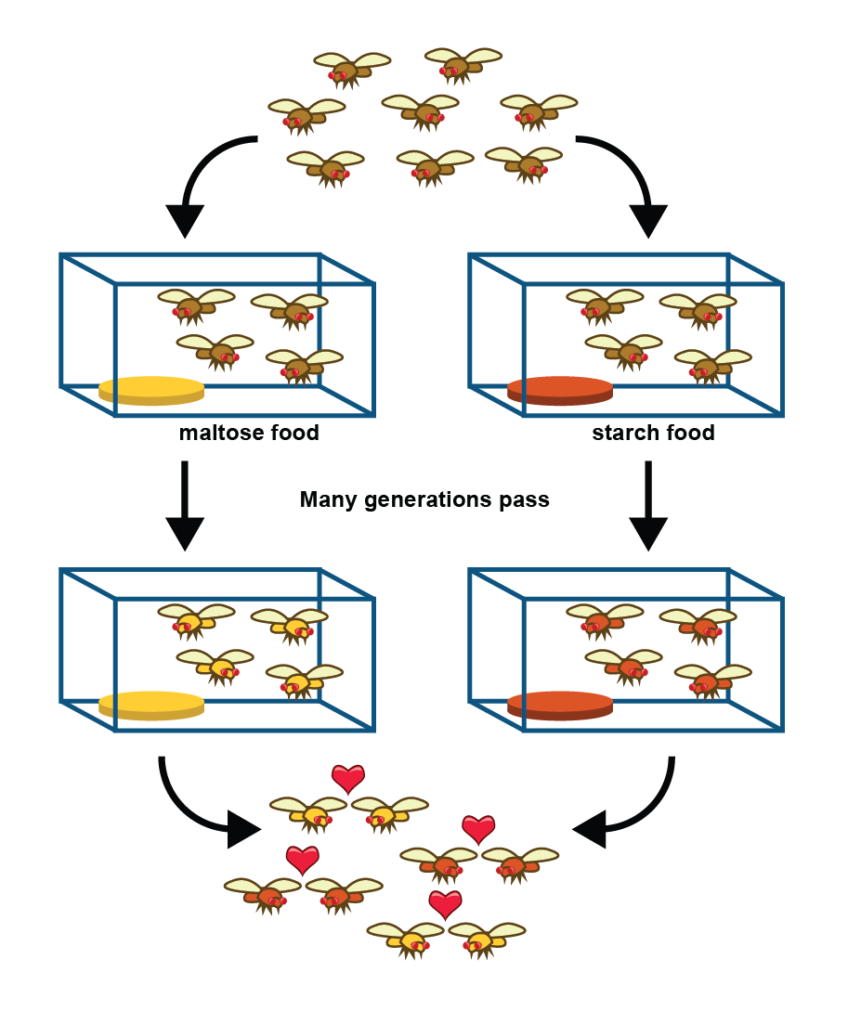
Diane Dodd’s fruit fly experiment suggests that isolating populations in different environments (e.g., with different food sources) can lead to the beginning of reproductive isolation. These results are consistent with the idea that geographic isolation is an important step of some speciation events.
Learn more about speciation:
- Speciation in real time, a news brief with discussion questions.
- A closer look at a classic ring species: The work of Tom Devitt, a research profile.