 UC Berkeley
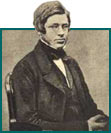
Today Alfred Russel Wallace (left) is a prisoner of scientific parentheses, as in, “the theory of evolution by natural selection proposed by Charles Darwin (and also by Alfred Russel Wallace).” Yet Wallace was a great naturalist in his own right, particularly in the way he used evolutionary theory to interpret the natural world. In one of his most important applications, he helped found the modern science of biogeography — the study of how species are scattered across the planet, and how they got that way.
Patterns of species’ ranges
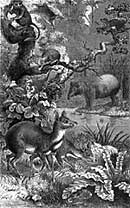
Wallace had already accepted evolution when he began his travels in 1848 through the Amazon and Southeast Asia. On his journeys, he sought to demonstrate that evolution did indeed take place, by showing how geography affected the ranges of species. He studied hundreds of thousands of animals and plants, carefully noting exactly where he had found them. The patterns he found were compelling evidence for evolution. He was struck, for example, by how rivers and mountain ranges marked the boundaries of many species’ ranges. The conventional explanation that species had been created with adaptations to their particular climate made no sense since he could find similar climatic regions with very different animals in them.
Wallace came to much the same conclusion that Darwin published in the Origin of Species: biogeography was simply a record of inheritance. As species colonized new habitats and their old ranges were divided by mountain ranges or other barriers, they took on the distributions they have today.
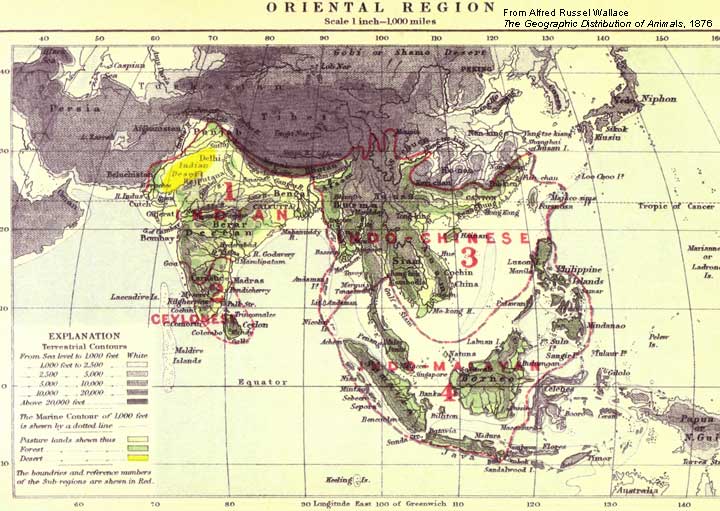
Wallace pushed the study of biogeography to grander scales than Darwin. As he traveled through Indonesia, for example, he was struck by the sharp distinction between the northwestern part of the archipelago and the southeastern, despite their similar climate and terrain. Sumatra and Java were ecologically more like the Asian mainland, while New Guinea was more like Australia. He traced a remarkably clear boundary that snaked among the islands, which later became known as “Wallace’s Line.” He later recognized six great biogeographical regions on Earth, and Wallace’s Line divided the Oriental and the Australian regions.
Plate tectonics
The biogeographic regions of the world that Wallace recognized roughly coincide with the continents themselves. But in the twentieth century, scientists have recognized that biogeography has been far more dynamic over the course of life’s history. In 1915 the German geologist Alfred Wegener (left) was struck by the fact that identical fossil plants and animals had been discovered on opposite sides of the Atlantic. Since the ocean was too far for them to have traversed on their own, Wegener proposed that the continents had once been connected. Only in the 1960s, as scientists carefully mapped the ocean floor, were they able to demonstrate the mechanism that made continental drift possible — plate tectonics.
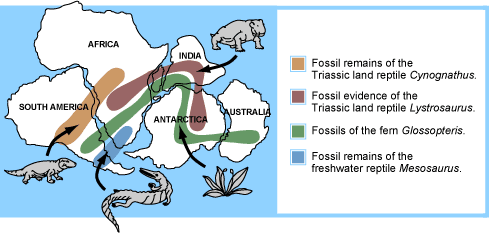
Biogeographers now recognize that as continents collide, their species can mingle, and when the continents separate, they take their new species with them. Africa, South America, Australia, and New Zealand, for example, were all once joined into a supercontinent called Gondwanaland. The continents split off one by one, first Africa, then New Zealand, and then finally Australia and South America. The evolutionary tree of some groups of species — such as tiny insects known as midges — show the same pattern. South American and Australian midges, for example, are more closely related to one another than they are to New Zealand species, and the midges of all three land masses are more closely related to one another than they are to African species. In other words, an insect that may live only a few weeks can tell biogeographers about the wanderings of continents tens of millions of years ago.
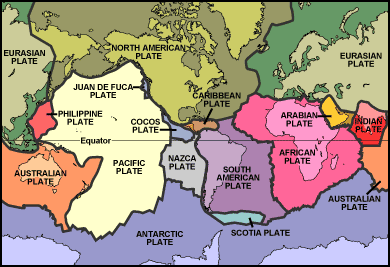
Read Wallace's 1858 manuscript on species. And see some demonstrations of plate tectonics.