 UC Berkeley
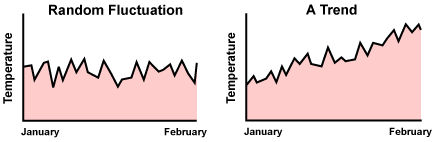
An evolutionary trend can be either directional change within a single lineage or parallel change across lineages, in other words, several lineages undergoing the same sort of change. However, not just any change counts as a trend. After all, if the weather gets warmer one day, you wouldn’t call it a warming trend; warming would have to go on for some length of time before you’d call it a trend. Biologists think about evolutionary trends in the same way — there has to be something about the change that suggests that it’s not just a random fluctuation before it counts as a “trend.”
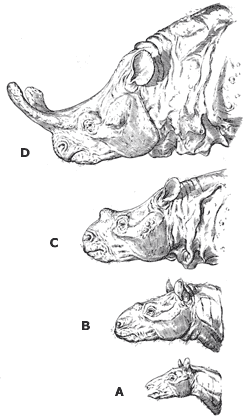
For example, titanotheres (a cool, extinct clade related to modern horses and rhinos) exhibit an evolutionary trend. Titanotheres had bony protuberances extending from their noses. The sequence of fossil skulls from these animals shows that evolutionary changes in the size of these “horns” were not random; instead, changes were biased in the direction of increasing horn size. And in fact, several different titanothere lineages experienced the same sort of change in horn size.
The titanothere reconstructions shown here range from about 55 mya (A) to 35 mya (D).The cause of this trend is not obvious. It may be a by-product of selection for increasing body size, and/or it may be a result of selection on horn size directly: big-horned individuals may have had an advantage in “butting” contests for females, as in sheep and goats.
Other evolutionary trends are not consistent across lineages. For example, biologists have long investigated whether there is a trend towards the evolution of larger body sizes. Since life started out so small, average body size has, of course, gone up over the course of life’s history. There was no direction to go but bigger! And of course, many lineages have remained microscopic throughout 3.5 billion years of evolutionary history. Some groups of macroscopic organisms (like non-avian dinosaurs and marine species) do seem to have evolved larger and larger body sizes over time. But there are also many examples of lineages that show no particular trend at all (e.g., horses) or seem to evolve smaller body sizes than their ancestors – for example, in cases of island-dwelling and parasitic lineages.
Is evolution progressive?
This is not an easy question to answer. From a plant’s perspective, the best measure of progress might be photosynthetic ability; from a spider’s it might be the efficiency of a venom delivery system.
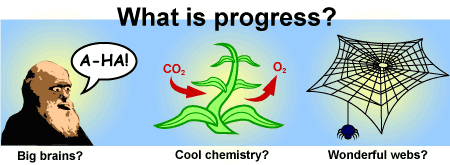
The problem is that we humans are hung up on ourselves. We often define progress in a way that hinges on our view of ourselves, a way that relies on intellect, culture, or emotion. But that definition is anthropocentric.
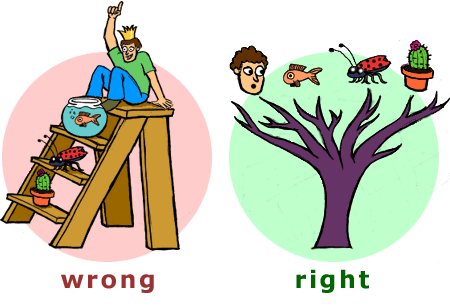
It is tempting to see evolution as a grand progressive ladder with Homo sapiens emerging at the top. But evolution produces a tree, not a ladder — and we are just one of many leaves on the tree.
Read more about what causes evolutionary trends and whether there is a trend toward complexity.
Learn more about evolutionary trends in context:
- Oxygen as an evolutionary constraint, a news brief with discussion questions.
Learn more about problems with the idea of progress in evolution:
- How to survive a mass extinction: The work of David Jablonski, a research profile.
Learn more about how evolution produces trees, not ladders:
- Seeing the tree for the twigs, a news brief with discussion questions
Reviewed and updated, June 2020.