 UC Berkeley
Tiktaalik, of course. Pronounced tik-TAA-lik, this 375 million year old fossil splashed across headlines as soon as its discovery was announced in April of 2006. Unearthed in Arctic Canada by a team of researchers led by Neil Shubin, Edward Daeschler, and Farish Jenkins, Tiktaalik is technically a fish, complete with scales and gills — but it has the flattened head of a crocodile and unusual fins. Its fins have thin ray bones for paddling like most fishes’, but they also have sturdy interior bones that would have allowed Tiktaalik to prop itself up in shallow water and use its limbs for support as most four-legged animals do. Those fins and a suite of other characteristics set Tiktaalik apart as something special; it has a combination of features that show the evolutionary transition between swimming fish and their descendants, the four-legged vertebrates — a clade which includes amphibians, dinosaurs, birds, mammals, and of course, humans.
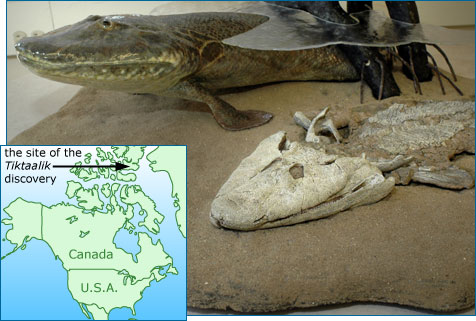
Where's the evolution?
All over the place! Evolution often makes an appearance in the news — but is usually buried in an article, underlying a forensic analysis or a new antibiotic, for example. In this case, evolution appeared front and center! Tiktaalik provides clues about a key transition in the history of life. Now extinct, this organism was a close relative of one our own ancestors — the first vertebrate to evolve four limbs and crawl out onto dry land. The evolutionary tree below shows the relationship between Tiktaalik, other fish, and four-legged vertebrates.
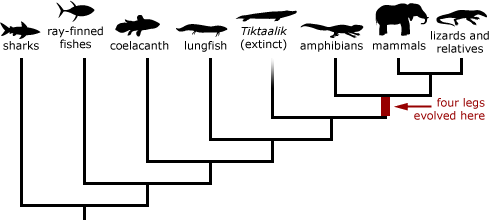
In many news articles, Tiktaalik was billed as “the missing link” between fish and land vertebrates — but that description is a bit misleading. First, Tiktaalik is more accurately described as a transitional form than a missing link. Transitional forms help show the evolutionary steps leading from one lineage to another by displaying characteristics of both the ancestral and the new lineage. These character suites help us understand the order in which the traits of the new lineage evolved and what functions they served as they evolved. Tiktaalik, for example, had fins with thin ray bones, scales, and gills like most fish. However, it also had the sturdy wrist bones, neck, shoulders, and thick ribs of a four-legged vertebrate. Tiktaalik was specialized for life in shallow water, propping itself up on the bottom and snapping up prey. The adaptations it had for this lifestyle ended up providing the stepping stones for vertebrates to climb onto dry land — but of course, Tiktaalik was not “aiming” to evolve features for land-living. Tiktaalik was simply well-adapted for its own lifestyle and later on, many of these features ended up being co-opted for a new terrestrial lifestyle.
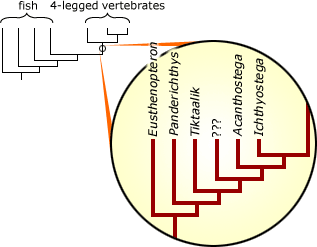
“Missing” links?
“Missing link” is an inappropriate term when referring to a transitional form not yet discovered in the fossil record. “Missing” usually describes something that was supposed to be present but has disappeared for unknown reasons — if, for example, a favorite book suddenly disappeared from your room But you wouldn’t describe the book as “missing” if you had lent it to a friend and expected it to be gone. The same arguments apply to so-called “missing links.” Biologists know that fossilization is a chancy process — most things that have lived on Earth are eaten or rot away before they can be fossilized. Very few organisms wind up in situations in which fossilization is possible and have body parts that can be preserved in fossils. Thus, biologists expect that most intervening steps of an evolutionary transition (such as vertebrates’ invasion of the land) will not be preserved in the fossil record. Occasionally, we get lucky and discover a transitional form that has been preserved in a fossil — but that does not imply that its ancestors, descendants, or other organisms that once lived on Earth are “missing.”
Second, a whole series of transitional forms tie fish to four-legged vertebrates — not the single, key organism suggested by the phrase “the missing link.” Before Tiktaalik was discovered, paleontologists had studied many other extinct transitional organisms, such as Eusthenopteron and Acanthostega, which also provided clues about vertebrates’ invasion of land. And as paleontologists continue to explore the fossil record, they are likely to uncover other organisms representing different points in this transition.
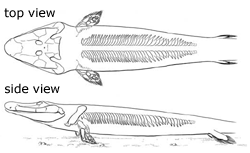
Image reprinted by permission from Macmillan Publishers Ltd: Nature 440, 757-763 (6 April 2006), copyright 2006.
Tiktaalik is important, well-preserved, and certainly newsworthy — but it was not unforeseen. The paleontologists who found Tiktaalik went looking for it. Previous research suggested that vertebrates’ invasion of land took place about 375 million years ago in a river — so Shubin and fellow researchers searched for fossils in 375 million year old rocks that had preserved a river delta ecosystem. Having studied other organisms from this water/land transition, the paleontologists knew what sort of animal they were looking for. And when they did discover Tiktaalik (after five separate expeditions to Canada), it wasn’t much of a surprise: Tiktaalik had the set of characteristics that they had expected to find in such an organism. In sum, discovering Tiktaalik simply confirmed many of the hypotheses biologists had held for a long time regarding the origin of terrestrial vertebrates. So although Tiktaalik didn’t revolutionize anyone’s thinking in this area, it does play an important role in moving science forward. Biologists can now capitalize on this knowledge to elaborate their hypotheses (about, for example, why vertebrates moved onto land), to make other predictions, and to discover more transitional forms: huge tracts of rock from this era remain unexplored and ripe for paleontological prospecting.
News update, June 2009
Since their initial publication on Tiktaalik, paleontologists Neil Shubin, Edward Daeschler, and Farish Jenkins, have continued to study its remarkable fossils. This past year, the team, now joined by Jason Downs, announced the results of a detailed analysis of Tiktaalik‘s skull.
Like its limbs, Tiktaalik‘s skull has a mix of traits that resemble fish in some ways and land-dwelling tetrapods in others. For an example, just look to your right or left. We tetrapods have necks, and so can keep our bodies still while moving our heads. Modern fish and Tiktaalik‘s ancestors, on the other hand, are neck-less and cannot. In this respect, Tiktaalik was more like us. Tiktaalik had lost some bones in its head, giving it a more mobile neck — which would have allowed it to rest its body on the bottom of a shallow pool and still turn its head to snap up food.
The new study also revealed that the bones of Tiktaalik‘s skull were somewhere between tetrapods’ and fishes’ in terms of how much they could move relative to one another. Our skulls, for example, are rigid and fused, whereas Tiktaalik‘s ancestors had more joints in their skulls, which allowed the bones to move to help with feeding and breathing underwater. Tiktaalik‘s skull fell between these two extremes. It still had some fish-like joints, but had evolved to be more rigid and stiff than that of its ancestors.
A cranial bone called the hyomandibula also illustrates how Tiktaalik helps connect ancient fish to modern tetrapods. In fish, this bone is large, attaches the upper jaw to the braincase, and helps with gill-breathing. In land-dwelling tetrapods, this bone is tiny — and in fact, has evolved an entirely new function: helping us hear. It became the stapes, one of the bones in your middle ear! The new research revealed that Tiktaalik‘s hyomandibula is smaller than that of its ancestors, but not nearly as small as the stapes. This probably means that Tiktaalik had evolved to rely less on pumping water across its gills to get oxygen — and that, in Tiktaalik‘s time, the hyomandibula had already begun the evolutionary journey that would eventually reshape it into the stapes.
Though these new findings are interesting, they are not surprising. Based on many other lines of evidence, we already knew that modern tetrapods evolved from a fish ancestor. Tiktaalik‘s cranium represents the mix of fish-like and tetrapod-like characteristics that we would expect to find in an organism closely related to the ancestral tetrapod. The new research simply reveals with even more clarity exactly how and when this gradual evolution occurred.
News update, June 2010
In 2010, scientists announced the discovery of fossil footprints that may call into question the timing of the evolution of four-legged vertebrates (i.e., tetrapods). Tiktaalik represents a close relative of the ancestor of tetrapods, and its fossils date to 375 million years ago. The first unambiguous fossils of tetrapod bones (e.g. Acanthostega) date to just after that time. These and many other lines of evidence support the idea that the first tetrapods evolved around then, probably between 385 and 391 million years ago. However, that date now seems less certain.
In January of this year, a group of Polish and Swedish paleontologists announced the discovery of nearly 400 million-year-old fossil footprints that seem to have belonged to a fully-formed tetrapod. If a full blown tetrapod was around 400 million years ago, the earliest tetrapods must have evolved long before then! Tiktaalik‘s fossils may be younger than the first tetrapods.
If scientists come to a consensus about the date of these footprints and the fact that they belonged to a tetrapod, would it contradict Tiktaalik‘s status as a transitional form? No. Tiktaalik‘s position on the evolutionary tree of tetrapod ancestors wouldn’t change a bit — after all, Tiktaalik would still have all the characteristics that help us understand the order and way in which tetrapods evolved. However, it would imply that Tiktaalik and early tetrapods like Acanthostega have long ghost lineages — a series of ancestors that lived but did not leave behind a fossil record. In other words, our best hypothesis regarding the evolutionary relationships among these organisms would not change, but we’d have to reevaluate the likely dates we assign to different branching points on the family tree of tetrapods and move many of them back in time.
Primary literature:
- Ahlberg, P. E., and Clack, J. A. (2006). A firm step from water to land. Nature 440:747-749.
- Daeschler, E. B., Shubin, N. H., and Jenkins, F. A. (2006). A Devonian tetrapod-like fish and the evolution of the tetrapod body plan. Nature 440:757-763. Read it »
- Downs, J.P., Daeschler, E. B., Jenkins Jr, F.A., and Shubin, N. H. (2008). The cranial endoskeleton of Tiktaalik roseae. Nature 455:925-929. Read it »
- Shubin, N. H., Daeschler, E. B., and Jenkins, F. A. (2006). The pectoral fin of Tiktaalik roseae and the origin of the tetrapod limb. Nature 440:764-771. Read it »
News articles:
- A newspaper article covering the discovery from The Los Angeles Times
- The University of Chicago's website describing how Tiktaalik was discovered
- A short summary of the importance of Tiktaalik from the National Science Foundation
- An in-depth review of the transition from water to land from Scientific American
Understanding Evolution resources:
- What is a transitional form? What makes Tiktaalik an example of a transitional form?
- Which features of Tiktaalik are similar to those of fishes? Which features of Tiktaalik are similar to those of four-legged vertebrates?
- Tiktaalik did not live on land, yet it had many features that terrestrial vertebrates alive today have. How can we explain those features? Were they adaptations? If so what were they adaptations for?
- Watch “Fish with Fingers” on the WGBH Evolution website. Compare Tiktaalik to Acanthostega in terms of anatomy and lifestyle.
- Watch “Fish with Fingers” on the WGBH Evolution website, which was recorded before the discovery of Tiktaalik. In that video, Jenny Clack hypothesizes that feet and legs did not evolve for walking on dry land but for maneuvering in shallow water. Does the discovery of Tiktaalik support or refute that hypothesis? Explain why or why not.
- Imagine that you read a newspaper article that describes Archaeopteryx as “the missing link between dinosaurs and birds.” Do some research on this organism and decide whether you think that is an accurate description. Explain why or why not.
- Teach about how fossils are formed: In this interactive module for grades 6-8, students are introduced to fossils and the fossilization process by examining how fossils are formed and the factors that promote or prevent fossilization.
- Teach about studying fossils: In this interactive web-based module for grades 6-8, students conduct a simulated field study at a fossil dig in Montana.
- Teach about how scientists learn about the past: This web-based module for grades 6-12 provides students with a basic understanding of how fossils can be used to interpret the past.
- Teach about another major transition in vertebrate history, the evolution of flight in birds: This interactive module for grades 9-12 examines evidence from the fossil record, behavior, biomechanics, and cladistic analysis to interpret the sequence of events that led to flight in the dinosaur lineage.
- Ahlberg, P. E., and Clack, J. A. (2006). A firm step from water to land. Nature 440:747-749.
- Daeschler, E. B., Shubin, N. H., and Jenkins, F. A. (2006). A Devonian tetrapod-like fish and the evolution of the tetrapod body plan. Nature 440:757-763.
- Downs, J.P., Daeschler, E. B., Jenkins Jr, F.A., and Shubin, N. H. (2008). The cranial endoskeleton of Tiktaalik roseae. Nature 455:925-929.
- Janvier, P., and Clément, G. (2010). Paleontology: Muddy tetrapod origins. Nature. 463: 40-41.
- Niedzwiedski, G., Szrek, P., Narkiewicz, K., Narkiewicz, M, and Ahlberg, P. E. (2010). Tetrapod trackways from the early Middle Devonian period of Poland. Nature. 463: 43-48.
- Shubin, N. H., Daeschler, E. B., and Jenkins, F. A. (2006). The pectoral fin of Tiktaalik roseae and the origin of the tetrapod limb. Nature 440:764-771.
- Wilford, J.N. (2008, October 16). Fish fossil yields anatomical clues on how animals of the sea made it to land. The New York Times. Retrieved May 27, 2009 from The New York Times.