 UC Berkeley
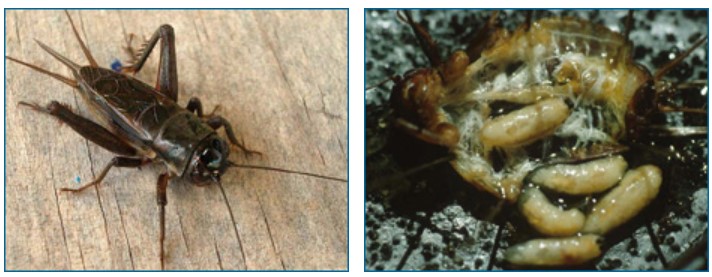
Attack of the flesh-eating parasitoid maggots!! Mutant mute crickets run rampant in tropical paradise!! The headlines may sound like a trailer for a cheap horror flick — but in fact, these sensationalist sound bites accurately describe the situation on the Hawaiian island of Kauai. The “flesh-eating parasitoid maggots” are the offspring of the fly, Ormia ochracea, which invaded Hawaii from North America, and the mutant crickets are the flies’ would-be victims. The flies follow the chirps of a calling cricket and then deposit a smattering of wriggling maggots onto the cricket’s back. The maggots burrow into the cricket, and emerge, much fatter, a week later — killing the cricket in the process. But this fall, biologists Marlene Zuk, John Rotenberry, and Robin Tinghitella announced a breakdown in business-as-usual in this gruesome interaction: in just a few years, the crickets of Kauai have evolved a strategy to avoid becoming a maggot’s lunch — but the strategy comes at a cost…
Where's the evolution?
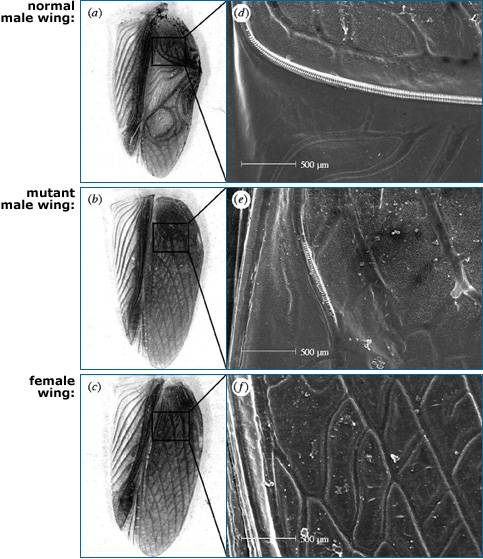
The evolution in this story hinges on what is probably a single mutation affecting wing shape in male crickets. Normal males have specially-equipped wings with a scraper and teeth that produce a chirp when rubbed together. Mutant males, on the other hand, have wings more like those of a female, without the noise-making features, turning them into something of an auditory cross-dresser: mutant males are silent like females and cannot chirp to attract a mate.
Mutation on the X chromosome
Based on mating experiments, the cricket wing mutation appears to be sex-linked. In humans, sex is determined by the X and Y chromosomes: XX individuals are female and XY individuals are male. However, crickets have no Y chromosomes: XX crickets are female and crickets with a single X (X- individuals) are male. The mutant wing gene is located on the cricket’s X chromosome, represented by the symbol Xm. All females (XX, XXm, and XmXm) have the normal mute female wings, X- males have the normal noisy male wings, but Xm– males have the mutant mute wings.
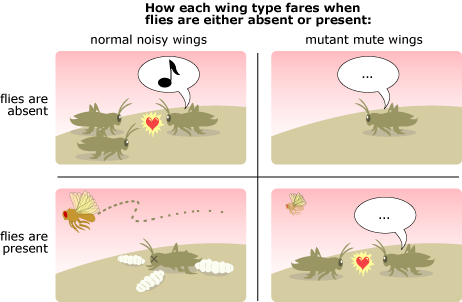
Which is more advantageous for a male cricket: normal noisy wings or mutant mute wings? Well, it depends. As shown in the diagram below, on islands without the parasitic fly, noisy-winged crickets have the advantage since they can attract mates with their calls — unlike the mutant crickets. On those fly-free islands, we’d expect natural selection to favor the normal crickets and weed out the mutant silent crickets — who would be less attractive to females, would get fewer chances to mate, and hence would leave behind fewer offspring. However, on fly-infested islands, mutants have the advantage; calling males get attacked by flies and eaten by maggots, while the silent males evade the flies and survive to mate another day. In that situation, natural selection favors the mutant crickets — though some calling males are likely to remain in the population because of their strong advantage when it comes to attracting a mate, as is the case on Kauai.
The island of Kauai is testimony to how quickly natural selection can operate under the right conditions. Between 1991 (when they started monitoring the situation on Kauai) and 2001, Marlene Zuk and her colleagues documented major declines in the island’s cricket population. The crickets seemed to be no match for the parasitic flies. In one study, 30% of calling males were infested with the parasite, and in 2001, the island was virtually silent: the team heard only one cricket call! Such intense parasitism represents strong selective pressure favoring any genetic change that helps the crickets evade the flies. And in 2003, the team discovered the result of that selection: the cricket population had bounced back! The island was again crawling with crickets — but of the silent sort. When the team investigated further, they discovered the wing mutation. Between the late 1990s and 2003, in just 20 or so cricket generations, Kauai’s cricket population had evolved into an almost entirely silent one!
So is that it? Problem solved by evolutionary ingenuity? Well, not quite… Natural selection is not a magic bullet; it simply selects the variants that work at a given time, in a particular environment, from what’s available in the population. Silent wings may be the key to avoiding parasitic flies — but they are also a serious liability when it comes to the local singles scene, since females locate mates by following their chirps. Currently, mutant mute males are dealing with their dating woes by hanging out near their literal “wingmen” — the few calling males remaining in the population. Female crickets are attracted to these callers but may get distracted by a mutant mute male en route.
A silent male that intercepts a female has made it over one hurdle, but even then, his mute wings are a major handicap in terms of reproductive success. Typically, a male cricket that has attracted a female would then perform a courtship song to seal the deal, but mutant males have no voice for that sweet-talking. For most female crickets, the lack of a courtship song would be a serious turn-off. However, Kauai’s females seem to be a bit less choosy and are willing to accept a silent male as a mate. Marlene Zuk and colleagues hypothesize that the Kauai population has evolved to be less choosy than other populations because of the high frequency of mute males on that island.
So far, the mute males’ bait-and-switch strategy for finding a mate seems to be working — after all, the frequency of the mutation has skyrocketed, and all those males carrying the mutation must have been fathered by mute males who had some mating success. Will this strategy succeed in the long run? It’s hard to say. The mute wings mutation is a trade-off — a brokered deal between selection for survival (avoiding parasitism) and sexual selection (attracting a mate). At the moment, because of the intensity of parasitism, selection for survival seems to have gained the upper hand, increasing the frequency of the mute wings mutation. But as calling males become rarer, calling might become more valuable in terms of reproductive success, shifting the balance of power towards sexual selection and increasing the frequency of normal wings in the population. Or because of the difficulty of locating their now nearly silent hosts, the fly population could crash, again changing the way that natural selection acts on the crickets. But whatever the ultimate fate of the Kauaian cricket population, their potential for rapid evolution is well-documented. These crickets have undergone major evolution in the past few years, and we should expect further evolutionary changes in their future.
News update, June 2008
Since their report on the rapid evolution of silent male crickets on Kauai, researcher Marlene Zuk and colleagues have continued to investigate this intriguing example of evolution in action. What they’ve learned has shed new light on how such a major shift in the cricket population occurred so quickly:
- Female crickets generally won’t mate with a male unless he sings a courtship song — so how are these mute males managing to reproduce and pass their silent wing mutation on to their offspring? The researchers wondered the same thing. Luckily, they had a group of laboratory crickets descended from the Kauaian population before the silent wing mutation arose, as well as a group from the post-mutation population. The scientists compared how females from the two groups responded to males and found that females from both groups were equally willing to mate with silent males. Kauaian female crickets seem to have a history of lax standards when it comes to choosing a mate. This suggests that it would have been easy for the silent mutation to gain a foothold in the Kauaian population since the females there had some proclivity for strong, silent types even before the handy mutation showed up in the population.
- How is the silent wing trait passed on to offspring? Further experiments have confirmed the researchers’ suspicions that the silent wing trait is caused by a mutation to a single gene located on the crickets’ X chromosome. This finding helps explain how the mutation rose to such high frequency in less than 20 generations — the blink of an eye in evolutionary terms. Single mutations (as opposed to a series of mutations in different genes working together) cannot be broken up by recombination and are expected to spread quickly if advantageous.
Marlene Zuk’s research group continues to investigate unanswered questions regarding this rapid evolutionary change. Are Kauaian females unusual in their lax standards? Is there any explanation for their benevolence towards mute males? What will the ultimate fate of the dwindling calling males be? Can the population survive if completely silenced? How will all of this affect the parasitic flies? As answers to these and other questions are discovered, we’ll keep you updated! The story is far from over …
News update, June 2011
Research on Hawaii’s quiet crickets continues! Most recently, Robin Tinghitella and her colleagues investigated the origins of the Hawaiian crickets to learn more about the situation in which the silent-winged crickets evolved. They collected DNA samples from crickets on the Hawaiian Islands, other Pacific islands, and Australia, and used the sequences to learn about the cricket’s evolutionary history. First, they discovered that the populations in Hawaii had extremely low genetic variation compared to the Australian populations and that the Pacific Island populations had intermediate levels of genetic variation. This is consistent with the idea that the crickets island hopped from Australia, to the Pacific Islands, to Hawaii — and that each time a group of crickets hopped to a new island, they carried only a small portion of the genetic variation present in the source population. Similarities among the sequences themselves also support this idea.
But how exactly did crickets “hop” over thousands of miles of open ocean? Tinghitella and her colleagues noticed that the crickets’ island-hopping pattern matched the likely movement of Polynesian settlers. The crickets may have come to Hawaii with the first human settlers, carried either on purpose, since crickets feature prominently in Polynesian folklore and traditions, or as stowaways.
However crickets got to Hawaii, it’s clear that there weren’t very many of them when they arrived. The low level of genetic variation in Hawaiian populations today strongly suggests that these crickets have experienced a population bottleneck — a reduction in population size, which probably occurred when small groups of crickets invaded a new island. This small starting population size could have contributed to the spread of the silent wing mutation today. When population size is small, selection may favor females that aren’t very choosy about their mates. After all, when there are only a few males to choose from, a picky female may not mate at all! If this is the case — if female crickets on Hawaii evolved to be less choosy early on, and as described in the news update above, it seems they did — it would have made it easier for the silent wing mutation to spread through the population. Unfussy females would accept silent partners and pass the silent gene on to their offspring.
Meanwhile, as researchers continue to study their evolution, the crickets themselves continue to evolve right under our noses! The mutation for silent wings seems to have been carried from Kauai to the population of crickets living on Oahu. Will it spread through that population as well? Stay tuned to find out …
For more about this research, check out Robin Tinghitella’s blog post on the topic.
News update, July 2014
At the time of our last update in the ongoing saga of Kauai’s silent crickets, chirpless males had just shown up on the nearby island of Oahu. Researchers hypothesized that the parasite-preventing mutation had spread to Oahu via a cricket from Kauai that had either flown there or caught a ride on a plane or boat (i.e., gene flow) — but now new research reveals that gene flow is not responsible after all.
In fact, silent wings seem to have arisen on Oahu through a new mutation specific to that population. Though the outcome of the Kauai and Oahu mutations is the same in terms of behavior (chirpless males) and both were favored and spread because of the same sort of natural selection (escaping detection by a parasitic fly), this is a case of convergent evolution, not gene flow. Several lines of evidence support the idea that the silent males on each island have distinct evolutionary origins. First, the wings of silent Kauai males look slightly different from the wings of silent Oahu males—that is, they have different phenotypes. The silent Oahu males have more remnants of the toothy, noisemaking vein on their wings than do the silent Kauai males. Second, although both of the mutations are located on the crickets’ X chromosome, genetic analysis suggests that they are distinct. The reasoning behind this conclusion takes some explaining. When a new, beneficial mutation occurs and rises to high frequency, it tends to bring nearby genetic variants with it. So for example, if a beneficial mutation happens to occur right next to a stretch of genetic code that reads ATAGATA, then as the beneficial mutation spreads through the population, so will the ATAGATA variant to which it is linked. In the case of the crickets, the researchers didn’t know exactly where on the X chromosome the original mutations had occurred, but they could figure out which genetic variants were associated with the mutation in each population. If the mutation had just occurred once and spread from Kauai to Oahu, then all of the silent males should have the same set of genetic variants “tagging along” with the beneficial mutation. If, however, convergent evolution is occurring, then each of the two mutations would have first arisen in different crickets carrying different genetic variants—and as each of the two mutations increased in frequency in their respective populations, they would each bring different variants along with them. In that situation, we would expect to see the silent wing trait associated with a different set of genetic variants on each island—and, in fact, this is exactly what researchers observed in their genetic analysis. Parasitoid flies have independently prodded the crickets of Kauai and Oahu into silence.
What’s next for these quiet crickets? Will singing males survive for the long term? Or will both populations become completely silent—and if they do, how will the crickets find their mates? We don’t yet know how this case of evolution in action will play out—but now we have two separate populations in which to watch it unfold. Stay tuned to see what happens next!
News update, May, 2016
Kauai’s crickets continue to evolve! Researchers have discovered that the evolutionary loss of calling ability has favored other evolutionary changes in the population as well. A recent study found that males from Kauai behaved differently than males from other islands when reared in an environment without cricket chirps. Specifically, they wandered around more—a trait that would likely help them find mates on an island where most crickets don’t call.
If you are a male cricket, there are a few strategies that could up your odds of finding a mate: 1) Call and let the females come to you; of course, this strategy is impossible if you were born without the ability to chirp and could get you eaten alive if your environment is infested with O. ochracea! 2) Poach a mate by hanging out near a chirping male and intercepting females attracted to his song, but of course, if all the males around you are also silent, this strategy is also a nonstarter. 3) Get moving and go out looking for a mate; it requires a lot of energy and the chances of success are low, but it could be your only viable option.
Researchers Susan Balenger and Marlene Zuk hypothesized that on the island of Kauai, where almost all males are of the silent type, crickets with a propensity for aggressively pursuing the third strategy would be more likely to mate and pass on their genes than crickets that stayed put, and so would be favored by natural selection. Specifically, the researchers hypothesized that the crickets would exhibit phenotypic plasticity—that is, they would behave differently depending on the environment in which they were reared: Kauaian crickets reared in an environment without calls should wander around in pursuit of females more (since they can’t depend on poaching mates from chirping neighbors), while Kauaian crickets reared with the sound of chirping should wander less. And that is exactly what the biologists found when they studied Kauaian crickets in a controlled lab environment. Crickets reared in silence moved more readily and spent more time walking around than crickets that heard chirps while they were maturing.
To see if this actually represents an evolutionary adaptation, the researchers compared the behavior of Kauaian crickets to that of crickets from Oahu (where 50% of the males chirp) and to the behavior of crickets from another island where all of the males chirp. Unlike the Kauaian crickets, the crickets from islands with more chirpers did not behave differently depending on whether or not they were reared in silence. This is exactly what we would expect to observe if the Kauaian cricket population had experienced evolution favoring crickets that are likely to go looking for a mate when it is advantageous to do so. Furthermore, since the crickets from all three islands were reared in the same lab environments, this is strong evidence that there is an underlying genetic difference between the populations that accounts for the Kauaian crickets’ phenotypic plasticity.
When researchers first discovered that a mutation causing silent wings was spreading through the Kauaian cricket population, they wondered how the male and female crickets would find each other if chirping crickets were entirely wiped out. Perhaps this adaptation provides part of the answer: simply by hoofing it. On the other hand, walking around to find a mate is not without drawbacks: it requires a lot of energy and could increase the wandering male’s chances of encountering a hungry cane toad. The future of the Kauaian cricket population still hangs in the balance. Stay tuned to find out what direction evolution takes this population in next!
News update, June, 2018
Our last update to the ongoing saga of Hawaii’s quiet crickets described how one evolutionary change (loss of singing ability) spurred an adaptive evolutionary change in behavior (increased wandering). Recent research documents the opposite phenomenon: lack of evolutionary change in behavior when we might expect to see it. As described above, the silence of Kauai’s crickets is caused by a physical change in the wings of mutant males: the scraper and file structures that normally rub together and produce noise are nearly absent. One might expect that in the mutant crickets, the energetically costly behavior of rubbing wings together would be selected against and evolve right out of the population. After all, once your noisemakers are gone, scraping wings against one another does nothing to attract females – and it wastes energy that could otherwise be used, for example, walking around looking for a mate. If natural selection always optimized populations, we might expect wing-rubbing behavior to be reduced in populations with lots of silent males. But when biologists studied the crickets, that’s not what they found. Males furiously scraped just the same, whether or not their wings produced any noise. This example highlights the limits of natural selection: it does not act instantaneously and it cannot act at all unless genetic variation for a more or less advantageous trait is present in the population. In the long term, wing rubbing may eventually be weeded out of silent populations. But biologists wonder if this behavior also opens up an evolutionary possibility for the crickets: traits that serve no current function (like wing rubbing in silent crickets) are not constrained by that function – and so have the possibility of accumulating new mutations that allow them to do something else entirely. Could the elements of wing rubbing be co-opted and adapted for some new, unforeseen purpose?
Primary literature:
- Bailey, N.W., McNabb, J.R., and Zuk, M. (2008). Pre-existing behavior facilitated the loss of a sexual signal in the field cricket Teleogryllus oceanicus. Behavioral Ecology 19:202-207. Read it »
- Mesa, A., Garcia-Novo, P., and dos Santos, D. (2002). X1X20(male) - X1X1X2X2 (female) chromosomal sex determining mechanism in the cricket Cicloptyloides americanus (Orthoptera, Grylloidea, Mogoplistidae). Journal of Orthoptera Research 11(1):87-90. Read it »
- Pascoal, S., Cezard, T., Eik-Nes, A, Gharbi, K., Majewska, J., Payne, E., ...Bailey, N. W. (2014). Rapid convergent evolution in wild crickets. Current Biology. 24: 1369-1374. Read it »
- Tinghitella, R. M., Zuk, M., Beveridge, M., and Simmons, L. W. (2011). Island hopping introduces Polynesian field crickets to novel environments, genetic bottlenecks and rapid evolution. Journal of Evolutionary Biology 24: 1199-1211. Read it »
- Tinghitella, R.M. (2008). Rapid evolutionary change in a sexual signal: genetic control of the mutation 'flatwing' that renders male field crickets (Teleogryllus oceanicus) mute. Heredity 100:261-267. Read it »
- Zuk, M., Rotenberry, J. T., and Tinghitella, R. M. (2006). Silent night: adaptive disappearance of a sexual signal in a parasitized population of field crickets. Biology Letters 2(4):521-524. Read it »
News articles:
- A complete description of the research from the UC Riverside newsroom
- National Geographic's summary of the discovery
Understanding Evolution resources:
- A brief review of sexual selection
- Clarification of common misunderstandings related to natural selection, including the misconception that natural selection is a magic bullet, which provides organisms with exactly what they need
- An advanced tutorial on DNA and mutations
Background information from Understanding Global Change:
- In what situations would you expect the silent wing mutation to be favored by natural selection? In what situations would you expect the normal wing version to be favored by natural selection? List at least two ideas for each.
- Read the comic strip Survival of the Sneakiest, which discusses the concept of evolutionary fitness. Explain what fitness means in terms of the Kauai crickets. What traits contribute to fitness in these crickets?
- Read about the concept of sexual selection. How has sexual selection affected male crickets on Kauai? How might sexual selection have affected female crickets on Kauai?
- This news brief describes traits which have been affected by sexual selection. Research and describe traits in other three other organisms that have been affected by sexual selection.
- Imagine that the parasitic fly goes completely extinct on the island of Kauai. Over the next five years how would you expect the cricket population on Kauai to evolve? Explain your reasoning.
- Use this information on the crickets’ genetics to answer the subsequent questions. Unlike humans, crickets have no Y chromosome. XX crickets are females and X- crickets are males. Male crickets carrying the m mutation on their X chromosome (Xm-) have silent wings. Female crickets have a different wing structure than males and so they never express the silent wing mutation even if they carry one (X Xm) or two copies (Xm Xm) of the mutant chromosome. If you performed an F1 cross, mating females from the pre-mutation population (XX females) with silent-winged males (Xm-), what ratios would you expect to observe in the genotypes of the male and female offspring? Among the male crickets, what would you expect the ratio of normal to silent wings to be? What would those ratios be among offspring of the F2 cross, in which the siblings from the F1 cross are mated together? Would these ratios be different if the mutation were recessive and were located on a normal chromosome (not on a sex chromosome)? The researchers who performed those crosses collected the following data. How well do they match your expectations for the X-linked system? For the non-X-linked, recessive system?
Normal-winged males 
Silent-winged males F1 offspring 670 1 F2 offspring 171 160
- Teach about sexual selection and fitness: This comic strip for grades 6-12 follows the efforts of a male cricket as he tries to attract a mate, and in the process, debunks common myths about what it means to be evolutionarily "fit."
- Teach about how natural selection acts on mutations: In this classroom activity for grades 9-12, students build, evolve, and modify paper-and-straw "birds" to simulate natural selection acting on random mutations.
- Bailey, N.W., McNabb, J.R., and Zuk, M. (2008). Pre-existing behavior facilitated the loss of a sexual signal in the field cricket Teleogryllus oceanicus. Behavioral Ecology 19:202-207.
- Balenger, S. L, and Zuk, M. (2015). Roaming Romeos: male crickets evolving in silence show increased locomotory behaviours. Animal Behaviour. 101: 213-219.
- Kaneshiro, K. Y. (1989) The dynamics of sexual selection and founder effects in species formation. In: Genetics, Speciation, and the Founder Principal (L. V. Giddings, K. Y. Kaneshiro, and W. W. Anderson, eds), pp. 279-296. Oxford University Press, Oxford, UK.
- Mesa, A., Garcia-Novo, P., and dos Santos, D. (2002). X1X20(male) - X1X1X2X2 (female) chromosomal sex determining mechanism in the cricket Cicloptyloides americanus (Orthoptera, Grylloidea, Mogoplistidae). Journal of Orthoptera Research 11(1):87-90.
- Pascoal, S., Cezard, T., Eik-Nes, A, Gharbi, K., Majewska, J., Payne, E., ...Bailey, N. W. (2014). Rapid convergent evolution in wild crickets. Current Biology. 24: 1369-1374.
- Schneider, W. T., Rutz, C., Hedwig, B., and Bailey, N. W. (2018). Vestigial singing behavior persists after the evolutionary loss of song in crickets. Biology Letters. 14: DOI: 10.1098/rsbl.2017.0754
- Tinghitella, R.M. (2008). Rapid evolutionary change in a sexual signal: genetic control of the mutation 'flatwing' that renders male field crickets (Teleogryllus oceanicus) mute. Heredity 100:261-267.
- Tinghitella, R. M., Zuk, M., Beveridge, M., and Simmons, L. W. (2011). Island hopping introduces Polynesian field crickets to novel environments, genetic bottlenecks and rapid evolution. Journal of Evolutionary Biology 24: 1199-1211.
- Zuk, M., Rotenberry, J. T., and Tinghitella, R. M. (2006). Silent night: adaptive disappearance of a sexual signal in a parasitized population of field crickets. Biology Letters 2(4):521-524.