 UC Berkeley
Evolutionary biologists are interested in understanding how humans fit into the history of life and how the processes of evolution have shaped us. Much scientific effort goes into studying human evolution, and as a result, our understanding of this area is moving forward rapidly, as new evidence emerges and hypotheses are tested, confirmed, discarded, or modified.
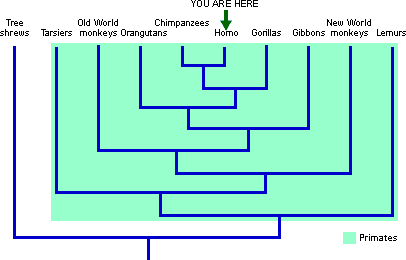
The location of our very own twig: Humans on the tree of life
This tree is based on morphological and genetic data. Chimpanzees and humans form a clade with DNA sequences that differ by only 1%. This genetic similarity made it hard to figure out exactly how these two primates are related, but recent genetic studies have strongly suggested that chimpanzees and humans are each other’s closest living relative.
How did humans evolve?
About six million years ago in Africa, the chimpanzee lineage and our own split. What happened to us after that split? The hominid lineage did not march in a straight line to Homo sapiens. Instead, the early hominid lineage gave rise to many other (now extinct) hominids. Examining the fossils, the artifacts, and even the DNA of these relatives has helped us understand how this complex hominid tree evolved, and how modern humans came to exist.
Here are some of the important events in human history, with approximate dates, which reflect the evidence currently available:
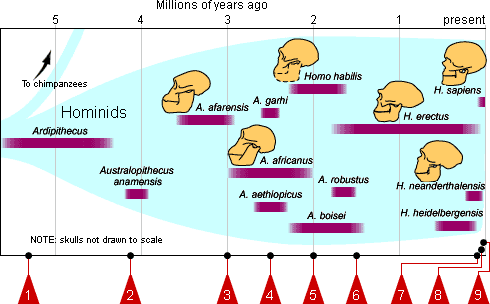
- Before 5 mya: In Africa, our ancestral lineage and the chimpanzee lineage split.
- Before 4 mya: The hominid Australopithecus anamensis walked around what is now Kenya on its hind legs.
- 3 mya: Australopithecus afarensis (“Lucy“) lived in Africa.
- 2.5 mya: Some hominids made tools by chipping stones to form a cutting edge. There were perhaps four or more species of hominid living in Africa.
- 2 mya: The first members of the Homo clade, with their relatively large brains, lived in Africa.
- 1.5 mya: Hand axes were used. Also, hominids had spread out of Africa and into much of Asia and Europe. These hominids included the ancestors of Neanderthals (Homo neanderthalensis) in Europe and Homo erectus in Asia.
- 100,000 years ago: Human brains reached more or less the current range of sizes. Early Homo sapiens lived in Africa. At the same time, Homo neanderthalensis and Homo erectus lived in other parts of the Old World.
- 50,000 years ago: Human cultures produced cave paintings and body adornment, and constructed elaborate burials. Also, some groups of modern humans extended their range beyond Africa.
- 25,000 years ago: Other Homo species had gone extinct, leaving only modern humans, Homo sapiens, spread throughout the Old World.
Learn more about how human evolution factored into the history of evolutionary thought.
Learn more about human evolution in context:
Teach your students about human evolution:
Find additional lessons, activities, videos, and articles that focus on human evolution.