 UC Berkeley
It’s clear why sexual selection is so powerful when you consider what happens to the genes of an individual who lives to a ripe old age but never produced offspring: no offspring means no genes in the next generation, which means that all those genes for living to a ripe old age don’t get passed on to anyone! That individual’s fitness is zero. Compare that to an individual who does not live very long, but leaves behind children…
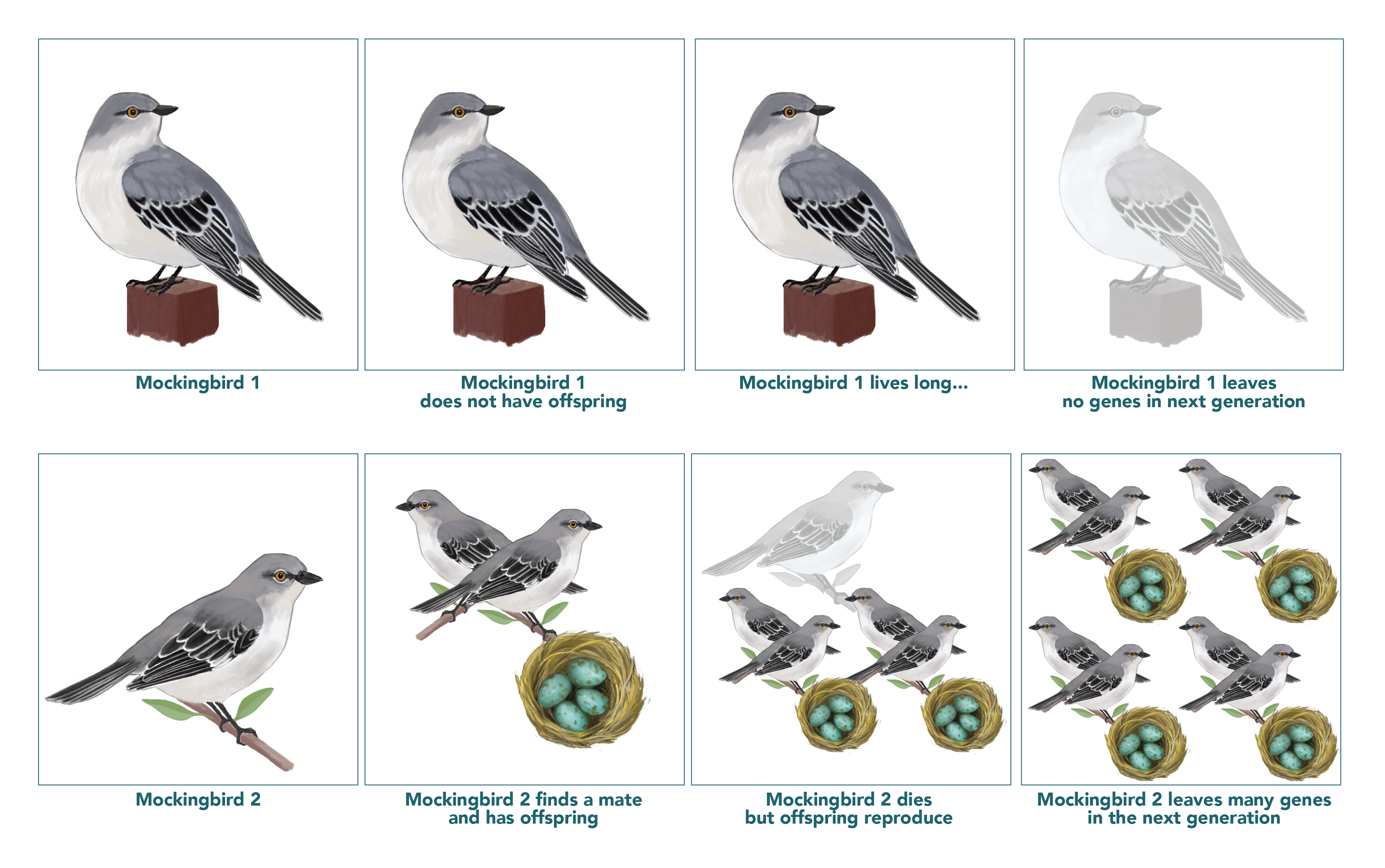
Selection is a two-way street
Sexual selection usually works in two ways, although in some cases we do see sex role reversals:
- Male competition
Males compete for access to females, the amount of time spent mating with females, and even whose sperm gets to fertilize her eggs. For example, male damselflies scrub rival sperm out of the female reproductive tract when mating. - Female choice
Females choose which males to mate with, how long to mate, and even whose sperm will fertilize her eggs. Some females can eject sperm from an undesirable mate.
Learn about how disadvantageous genes can spread through the process of runaway sexual selection.
Learn more about sexual selection in context:
- Survival of the sneakiest, a comic strip with discussion questions.
- Evolution's dating and mating game, a news brief with discussion questions.
- Quick evolution leads to quiet crickets, a news brief with discussion questions.
- Grasshoppers change their tune. Is it evolution in action?, a news brief with discussion questions.
Reviewed and updated, June 2020.