 UC Berkeley
Macroevolution generally refers to evolution above the species level. So instead of focusing on an individual beetle species, a macroevolutionary lens might require that we zoom out on the tree of life, to assess the diversity of the entire beetle clade and its position on the tree.
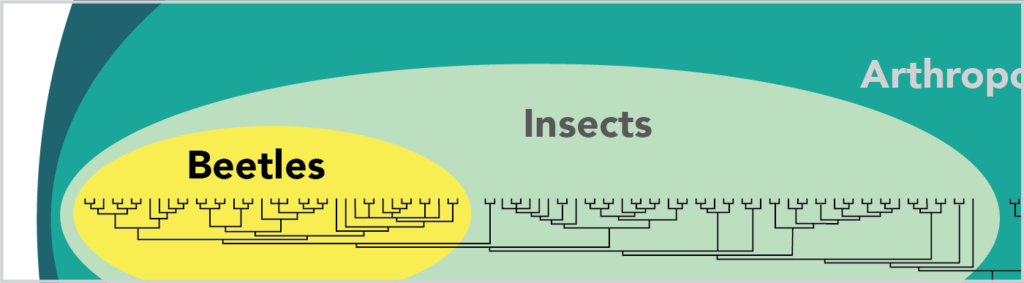
Macroevolution encompasses the grandest trends and transformations in evolution, such as the origin of mammals and the radiation of flowering plants. Macroevolutionary patterns are generally what we see when we look at the large-scale history of life.
It is not necessarily easy to “see” macroevolutionary history; there are no firsthand accounts to be read. Instead, we reconstruct the history of life using all available evidence: geology, fossils, and living organisms.
Once we’ve figured out what evolutionary events have taken place, we try to figure out how they happened. Just as in microevolution, basic evolutionary mechanisms like mutation, migration, genetic drift, and natural selection are at work and can help explain many large-scale patterns in the history of life.
The basic evolutionary mechanisms — mutation, migration, genetic drift, and natural selection — can produce major evolutionary change if given enough time.

A process like mutation might seem too small-scale to influence a pattern as amazing as the beetle radiation, or as large as the difference between dogs and pine trees, but it’s not. Life on Earth has been accumulating mutations and passing them through the filter of natural selection for 3.8 billion years — more than enough time for evolutionary processes to produce its grand history.
Read more about interpreting the evidence relevant to macroevolution.
Learn more about macroevolution in context:
- How to survive a mass extinction: The work of David Jablonski, a research profile.
- Ancient fossils and modern climate change: The work of Jennifer McElwain, a research profile.
- Where species come from, a news brief with discussion questions.
- Understanding macroevolution through evograms, a module exploring five examples of macroevolution as documented in the fossil record.
Teach your students about macroevolution:
- Visualizing life on Earth: Data interpretation in evolution, a web activity for grades 9-12.
- Interactive investigation: The arthropod story, a web activity for grades 6-12.